Did you know — Korean culture
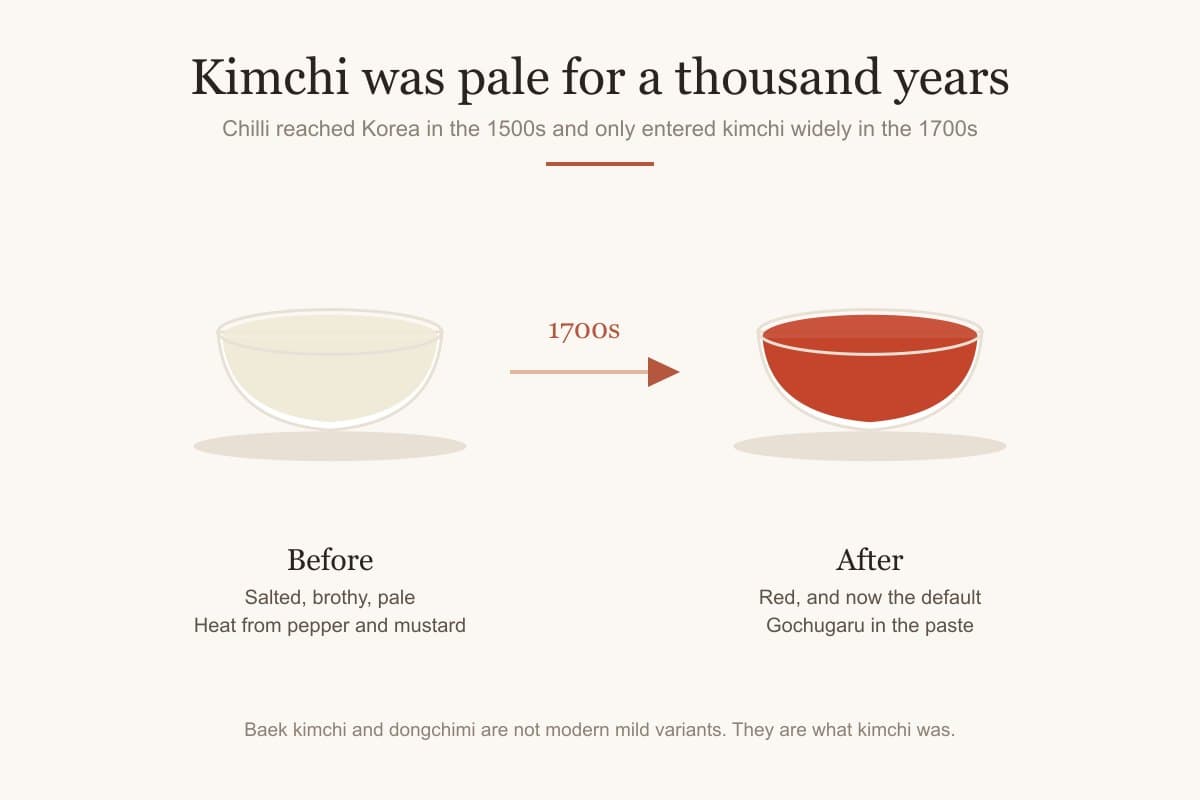
For most of its history kimchi looked more like sauerkraut than like the red version everyone pictures. Chilli only reached Korea in the sixteenth century and was not widely used in kimchi until the eighteenth, so for well over a thousand years kimchi was a pale, salted, sometimes brothy preserve. That older form still exists and is still made — baek kimchi and dongchimi are not modern mild variants, they are what kimchi was.
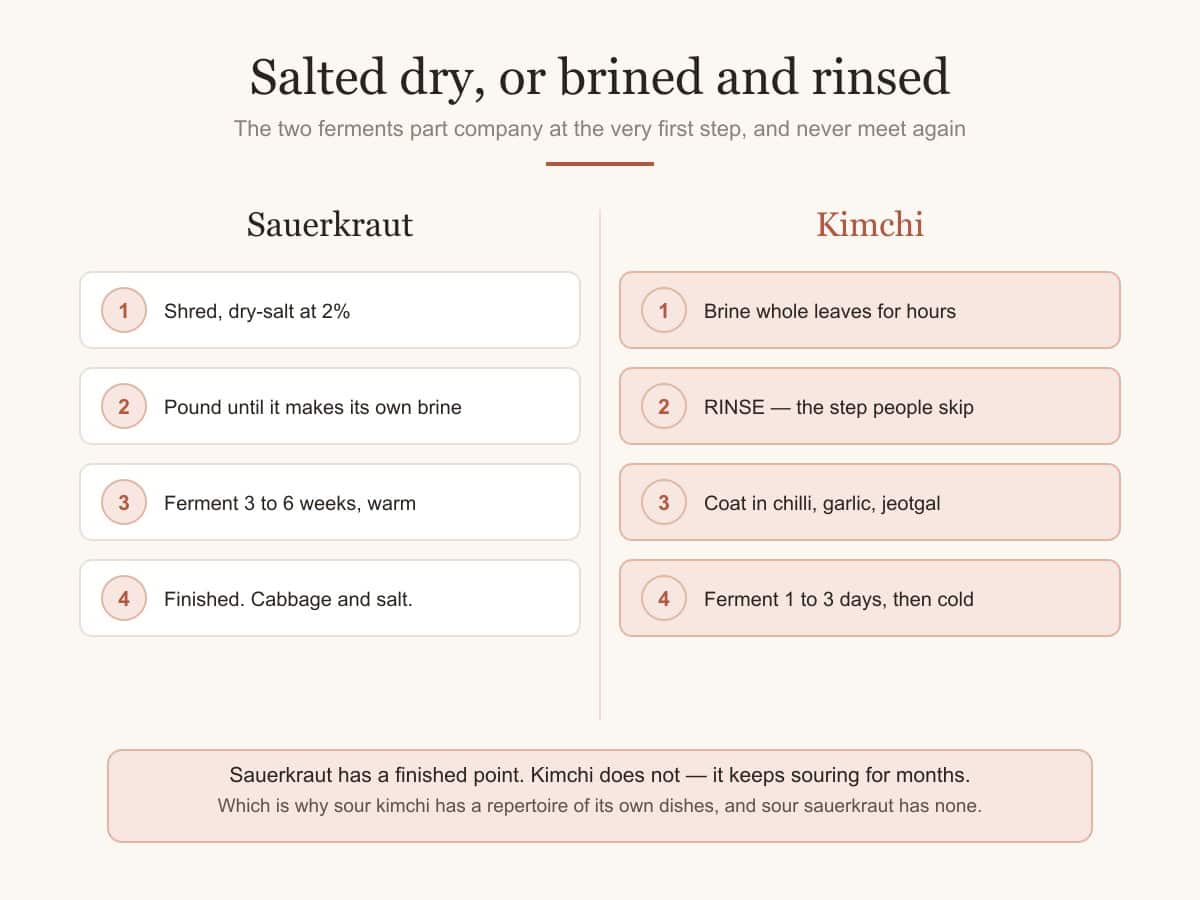
Two fermented cabbages, the same family of bacteria, almost nothing else in common. The differences start at the salting and compound from there.
Sauerkraut is salted dry and left plain. Kimchi is brined, rinsed, then coated in a seasoning paste. Everything downstream follows from that.
How the salt goes in
Sauerkraut is shredded and dry-salted at roughly 2% of its weight, then pounded until it releases enough liquid to submerge itself. It ferments in its own brine, anaerobically, under a weight.
Kimchi is salted in a wet brine for a few hours, then rinsed — see how to salt napa cabbage — and only then mixed with its paste. The salt is a pre-treatment, not the whole preservation.
That rinse is the step people coming from sauerkraut consistently skip, and it is why their kimchi comes out too salty.
What goes in besides cabbage
Sauerkraut is cabbage and salt. Caraway sometimes. The flavour is entirely the ferment.
Kimchi is a seasoned preparation: gochugaru, garlic, ginger, spring onion, Korean radish, usually a rice-flour porridge and usually some jeotgal. The ferment develops on top of a dish that already tastes of something.
It also uses different cabbage. Napa is looser, thinner-leaved and far wetter than the dense green cabbage sauerkraut wants — they do not swap, as napa cabbage substitutes covers.
How long, and how cold
Sauerkraut typically ferments three to six weeks at room temperature and is considered finished.
Kimchi is usually fermented one to three days warm and then refrigerated, where it keeps changing for months. There is no finished point — fresh kimchi and sour kimchi are different ingredients for different dishes.
That is the most practical difference in a kitchen. You buy sauerkraut as a product and kimchi as a moving target.
What each does in cooking
Sauerkraut is mostly eaten as it is, or braised long and slow where its acidity softens.
Sour kimchi is a base ingredient, and the sourer it gets the more useful it becomes: kimchi jjigae, kimchi bokkeumbap, kimchi jeon. Korean cooking has a whole repertoire for kimchi that has gone too far to eat raw.
Substituting one for the other does not work. Sauerkraut in kimchi jjigae gives you a sour cabbage soup with no chilli, garlic or depth; kimchi anywhere sauerkraut belongs brings heat and seafood that nothing in the dish expects.
Common questions
Is kimchi just Korean sauerkraut?
No. Sauerkraut is cabbage and salt fermenting in its own brine; kimchi is brined, rinsed, then coated in a paste of chilli, garlic, ginger and usually fermented seafood before it ferments at all.
Can I substitute sauerkraut for kimchi?
Not usefully. In a kimchi jjigae it gives a sour cabbage soup with none of the chilli, garlic or depth the dish is built on. The acidity is the only thing the two share.
Which is better for gut bacteria?
Both are live lacto-fermented foods with broadly comparable bacterial counts when unpasteurised. The meaningful difference is that most shop sauerkraut is pasteurised and most shop kimchi is not.
Does kimchi ever stop fermenting?
Not really. Refrigeration slows it, but kimchi keeps souring for months, and Korean cooking treats the later stages as a separate ingredient rather than as spoilage.
More to cook
All Ingredient & Substitute Guides
Kkaennip (Perilla Leaves)
Why Korean perilla leaves are not shiso despite looking similar, how they're used in ssam and jangajji, and what to do if you can't find them fresh.

Korean Banchan: A Complete Guide
What banchan actually are, how many a Korean meal needs, which ones keep for weeks, and how to build a table without cooking all day.
Korean BBQ at Home: The Complete Guide
How to run a Korean barbecue in a normal kitchen — which cuts to buy, what belongs on the table, and the order a proper meal actually follows.