Did you know — Korean culture
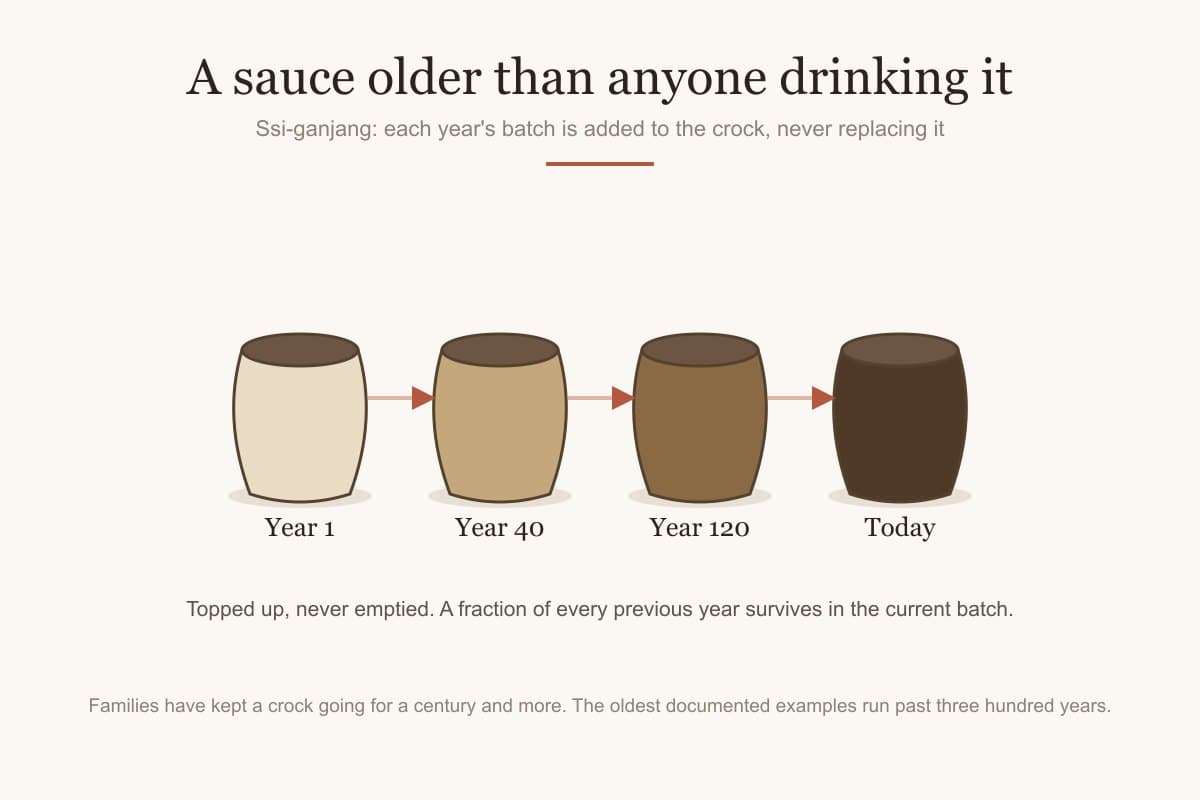
Some Korean households keep a soy sauce that is older than anyone alive in them. The practice is called ssi-ganjang, seed soy sauce: each year's fresh ganjang is added to the standing crock rather than replacing it, so a fraction of every previous year survives in the current batch. Families have maintained crocks for a century and more this way, and the oldest documented examples run past three hundred years. The sauce is never finished and never started — it is topped up, and inherited.
A Korean recipe that says ganjang usually means something specific, and the two main kinds are not interchangeable. One is for soups, one is for everything else, and using the wrong one is a common and entirely invisible mistake.
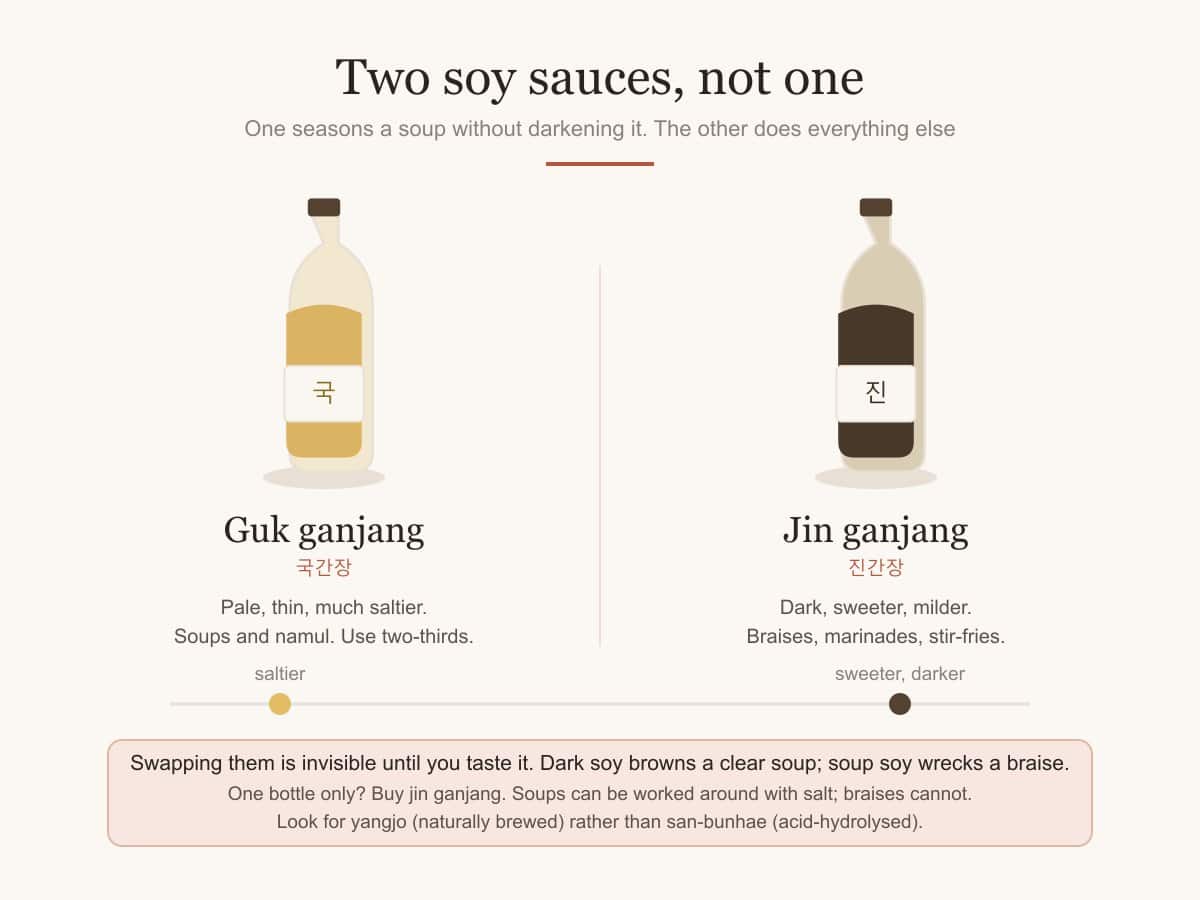
Guk ganjang is paler and much saltier. Jin ganjang is darker, sweeter and milder.
Guk ganjang: soup soy sauce
Also called joseon ganjang or jaeraesik ganjang. It is the liquid drawn off a traditional doenjang ferment — the same crock, the same batch.
Pale amber, thin, and noticeably saltier than ordinary soy sauce. It seasons without darkening, which is the entire point: a clear soup stays clear.
Use it in miyeok guk, sogogi muguk, kongnamul gukbap and in namul seasoning. Use roughly two-thirds of what a recipe would ask for in regular soy sauce, and taste.
Jin ganjang: everything else
Dark, brewed, often with wheat, and closer to Japanese soy sauce than guk ganjang is. Sweeter and less aggressively salty.
This is what goes into braises, marinades and stir-fries — jangjorim, bulgogi, dubu jorim, ganjang gejang.
It is also the bottle most people already own. If a recipe does not specify, it almost certainly means this one.
What happens if you swap them
Jin ganjang in a clear soup turns the broth brown and flat. It looks wrong and tastes muddier than it should; the dish is edible and visibly not what it was meant to be.
Guk ganjang in a braise oversalts it badly, because you poured a volume calibrated for a milder sauce. There is no fixing a jangjorim seasoned this way.
The second mistake is worse than the first, which is a reason to keep the darker bottle as the default if you only have one.
If you only want one bottle
Buy jin ganjang. It covers most of the repertoire, and in a soup you can compensate by seasoning with salt and using a smaller pour of dark soy for depth.
Going the other way does not work: nothing substitutes for jin ganjang's sweetness and body in a braise.
Two more labels you will meet: yangjo ganjang is naturally brewed and worth the difference; san-bunhae ganjang is acid-hydrolysed, fast and harsh. Check for yangjo on the bottle — it is the single most useful word on a Korean soy sauce label.
Common questions
What is soup soy sauce in Korean recipes?
Guk ganjang, also sold as joseon ganjang. It is pale, thin and much saltier than ordinary soy sauce, and it seasons a clear soup without turning it brown.
Can I use regular soy sauce instead of guk ganjang?
In a soup you can get close by seasoning with salt plus a small pour of regular soy, but the broth will darken. Going the other way — guk ganjang in a braise — oversalts it badly.
Which Korean soy sauce should I buy first?
Jin ganjang. It covers braises, marinades and stir-fries, which is most of the repertoire, and soups can be worked around with salt.
What does yangjo mean on a soy sauce bottle?
Naturally brewed. The alternative, san-bunhae, is acid-hydrolysed — faster to make and noticeably harsher. Yangjo is the most useful word on the label.
More to cook
All Ingredient & Substitute Guides
Guk vs Jjigae vs Jeongol
Korean has three words for what English calls soup, and they are not interchangeable. What separates them, and which dishes belong to which.
Walnuts in Korean Cooking (Hodu)
Where walnuts turn up in Korean food beyond hodu-gwaja, why they are blanched before candying, and how to keep them from turning bitter.
How to Salt Napa Cabbage for Kimchi
How long to brine napa cabbage, the bend test that tells you it is ready, and why rinsing three times is not excessive.