Did you know — Korean culture
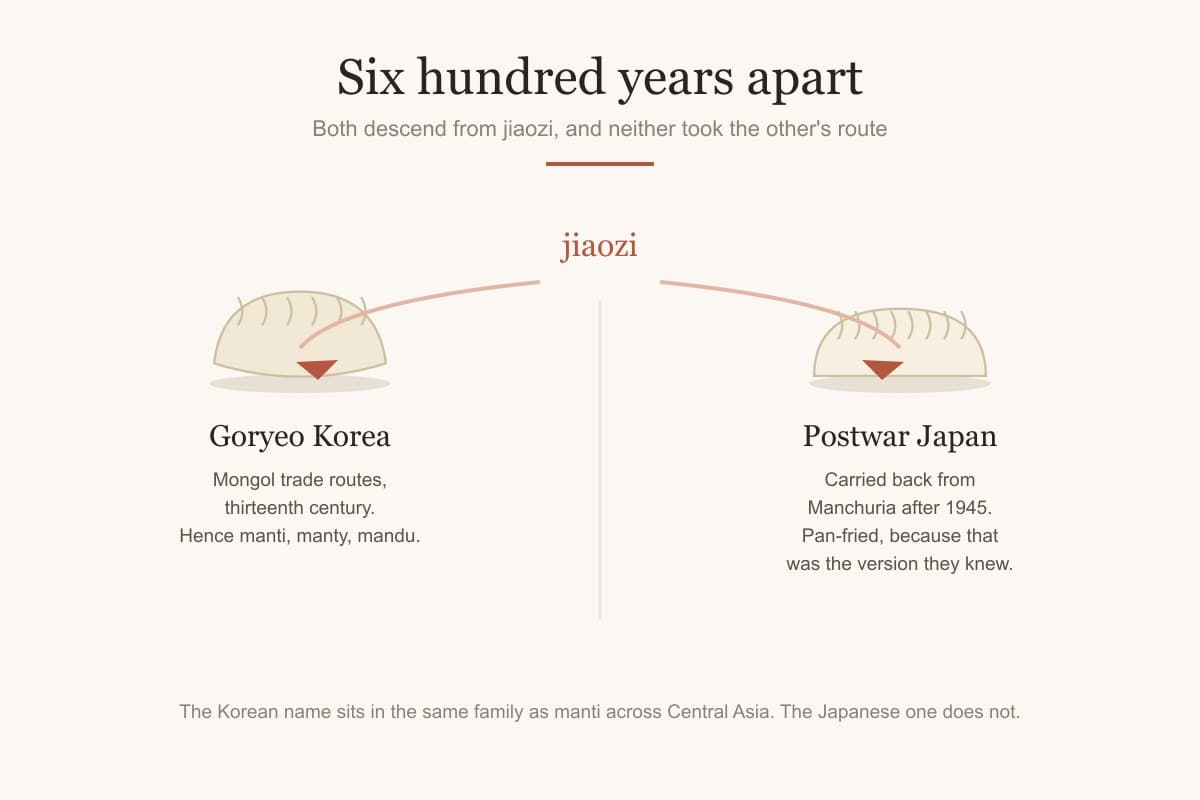
The two dumplings arrived in their countries about six hundred years apart. Mandu came to Korea during the Goryeo period along the routes the Mongol empire opened, which is why the Korean name sits in the same family as manti and manty across Central Asia. Gyoza reached Japan in the twentieth century, mostly carried back by soldiers and civilians returning from Manchuria after 1945, and the pan-fried form became standard there because that was the version those returnees had eaten.
Both descend from the Chinese jiaozi, and both reached their countries by different routes. They are closer to each other than either is to its ancestor, and they are still distinguishable on sight.
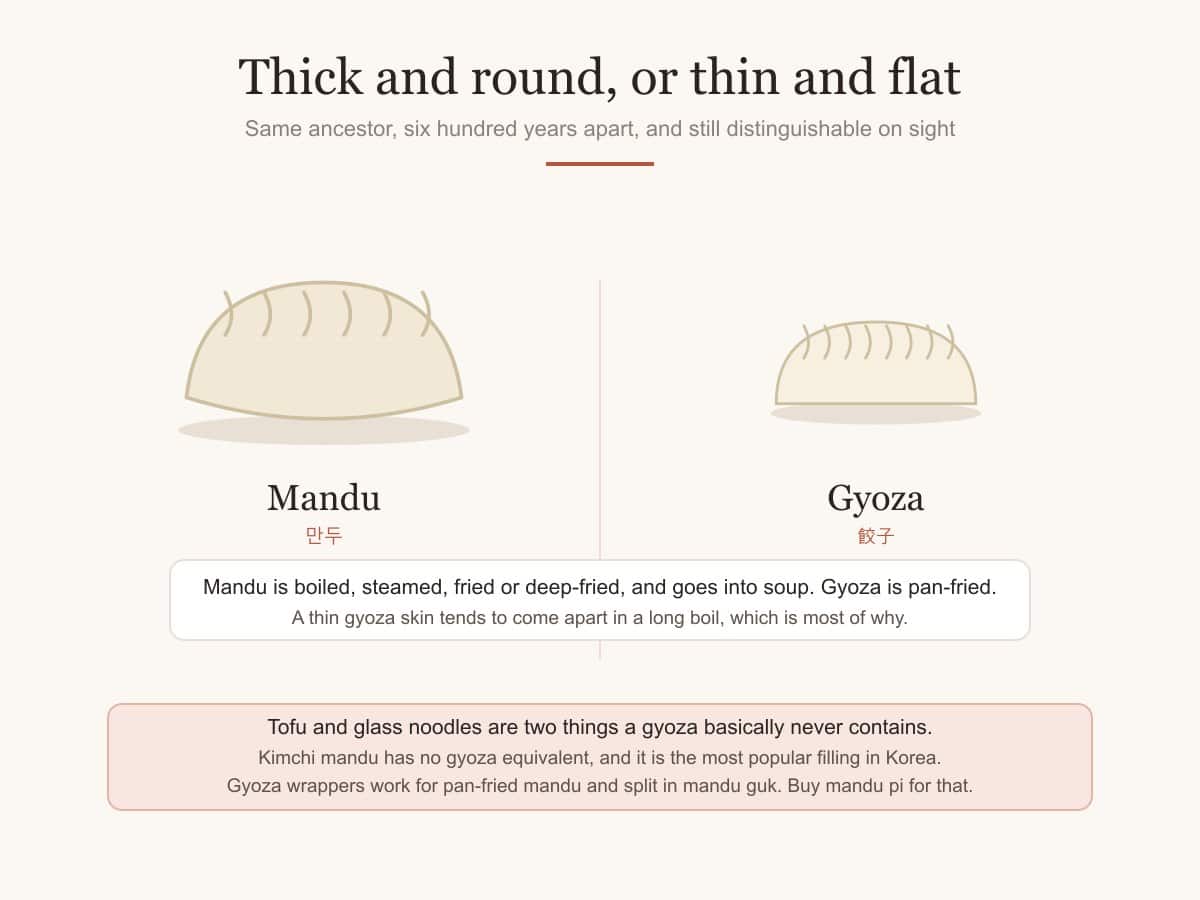
Mandu is bigger, rounder and more loosely filled. Gyoza is small, flat-bottomed and tightly packed.
The wrapper
Mandu wrappers are thicker, and the dumpling is usually larger — often two or three bites.
Gyoza wrappers are thin, deliberately so, because the dish is built around a crisp base and a translucent top.
The practical effect is on cooking. A thicker mandu skin survives boiling and steaming; a thin gyoza skin is at its best pan-fried and tends to disintegrate in a long boil.
What goes in
Mandu filling is chunkier and more vegetable-forward: cabbage, spring onion, tofu, dangmyeon noodles, minced pork or beef, and very often kimchi. Tofu and noodles are the two ingredients a gyoza basically never has.
Gyoza filling is finer and leans harder on garlic and cabbage, with pork the default meat.
Kimchi mandu has no real gyoza equivalent, and it is the single most popular filling in Korea.
Shape and cooking
Gyoza is folded into a flat-bottomed crescent with pleats along one side, because it is designed to sit in a pan. It is nearly always pan-fried, then steamed under a lid.
Mandu takes several shapes: the crescent, the round purse, and the pinched-ring gullin mandu. All four cooking methods are normal — boiled, steamed, pan-fried and deep-fried.
And boiled mandu goes into soup, which gyoza rarely does. Mandu guk and tteok mandu guk are standard dishes rather than a way of using leftovers.
At the table
Gyoza is a side, usually alongside ramen or as an izakaya plate, with a soy-vinegar-chilli oil dip.
Mandu is often the meal, or a major part of one, and at new year it is specifically ceremonial.
The dipping sauce differs too: the Korean one is soy and vinegar with gochugaru and sesame, and is usually less sharp than the Japanese version.
Common questions
What is the difference between mandu and gyoza?
Mandu is larger with a thicker wrapper and a chunkier filling that often includes tofu, glass noodles or kimchi. Gyoza is small, thin-skinned, flat-bottomed and built for pan-frying.
Can I use gyoza wrappers for mandu?
For pan-fried mandu, yes. For boiled mandu or mandu guk they are too thin and tend to split, so look for the thicker wrappers sold as mandu pi.
Is kimchi mandu a type of gyoza?
No — it has no real gyoza equivalent. It is the most popular mandu filling in Korea and belongs entirely to that tradition.
Which came first?
Both descend from Chinese jiaozi. Mandu reached Korea during the Goryeo period along Mongol trade routes; gyoza reached Japan much later, in the twentieth century, largely via returnees from Manchuria.
More to cook
All Ingredient & Substitute Guides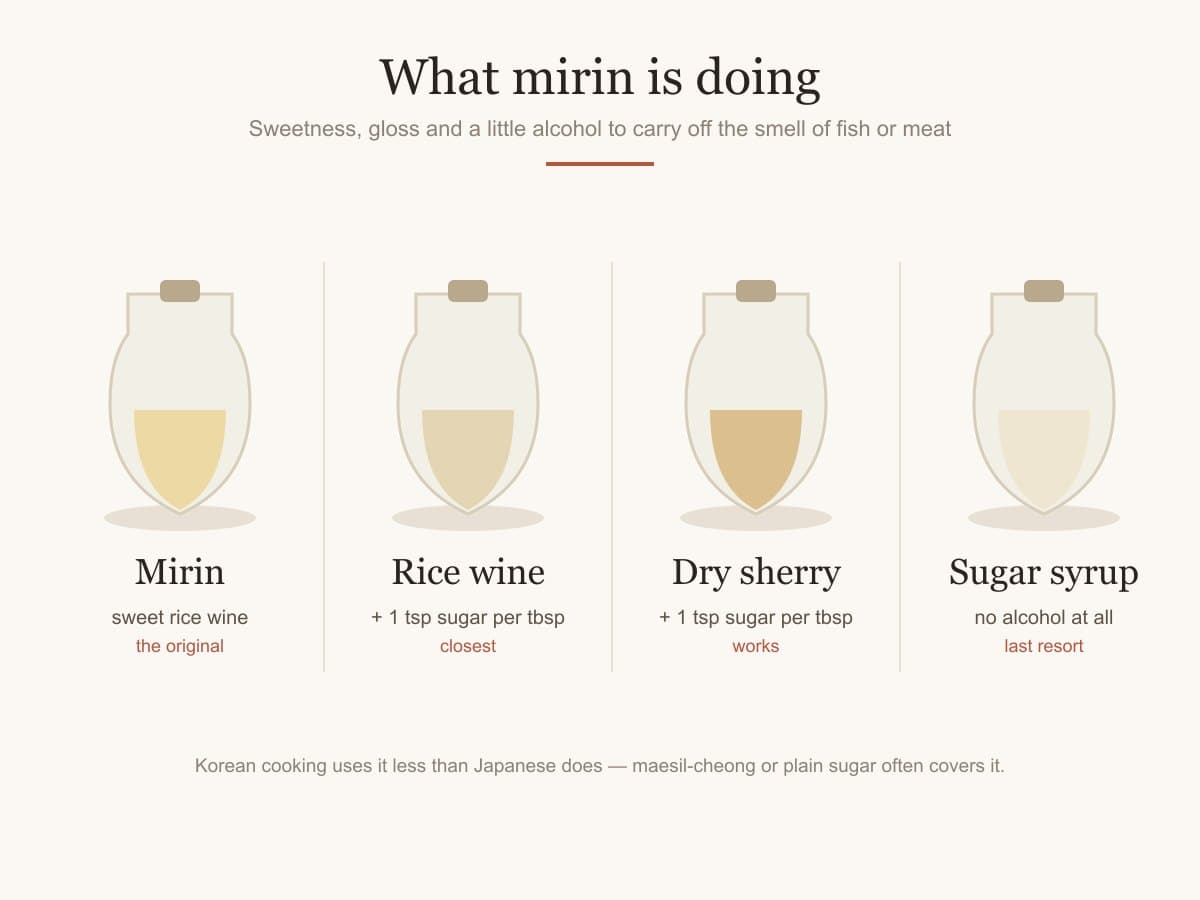
Mirin Substitute
What mirin actually contributes to a Korean marinade, the substitutes that hold up, and why Korean cooking needs it less often than Japanese cooking does.
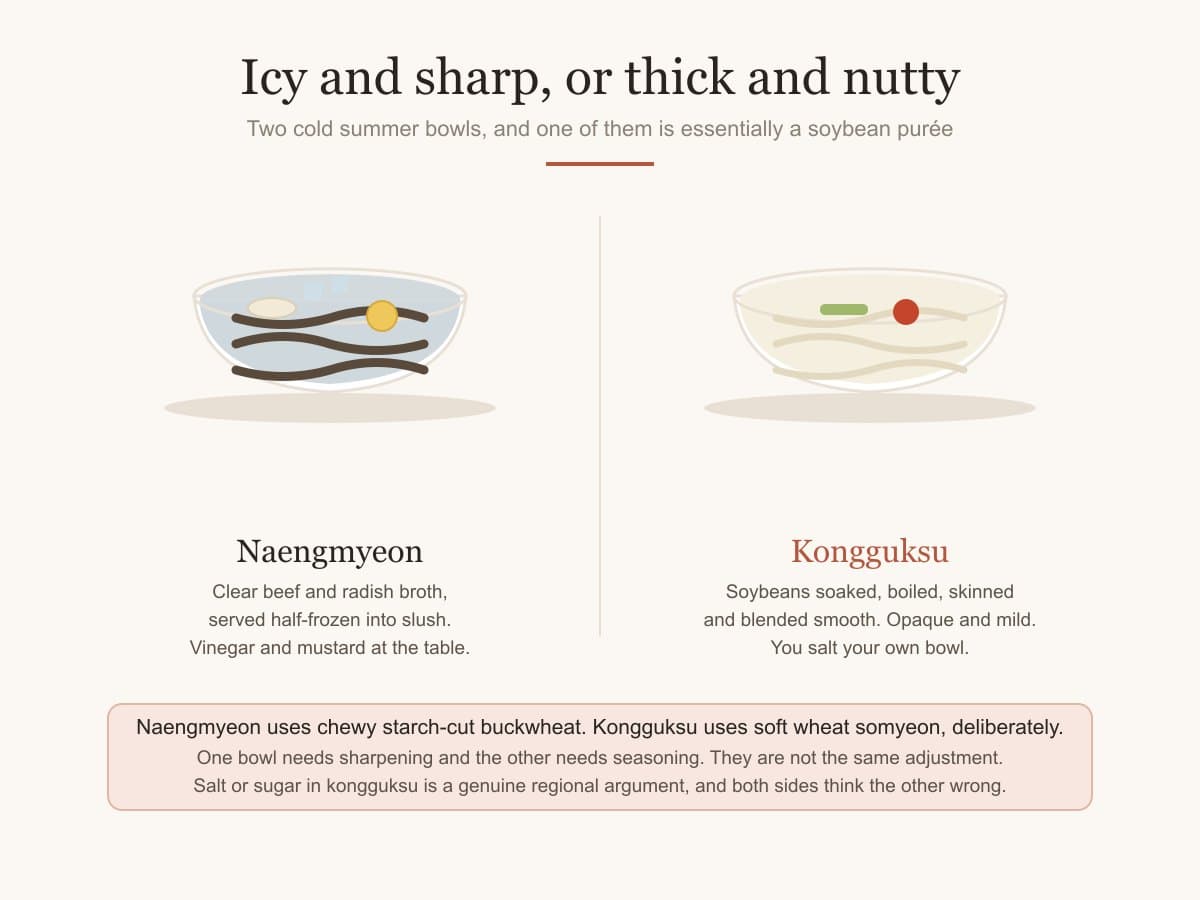
Naengmyeon vs Kongguksu
Both are cold noodle soups eaten in summer and they could not be less alike. Icy and sharp against thick and nutty.
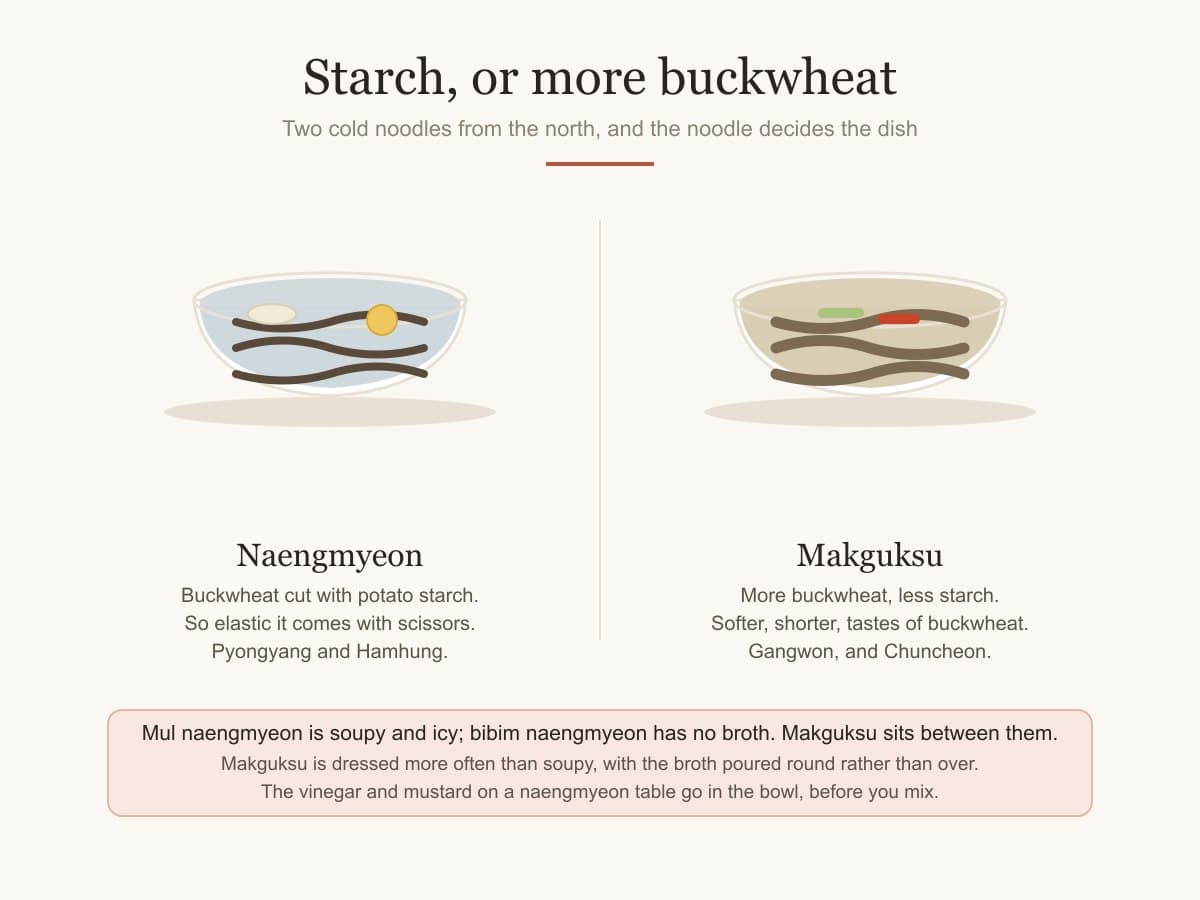
Naengmyeon vs Makguksu
Both are cold buckwheat noodles from the north. The noodle, the broth, the region and how each one is actually served.