Did you know — Korean culture
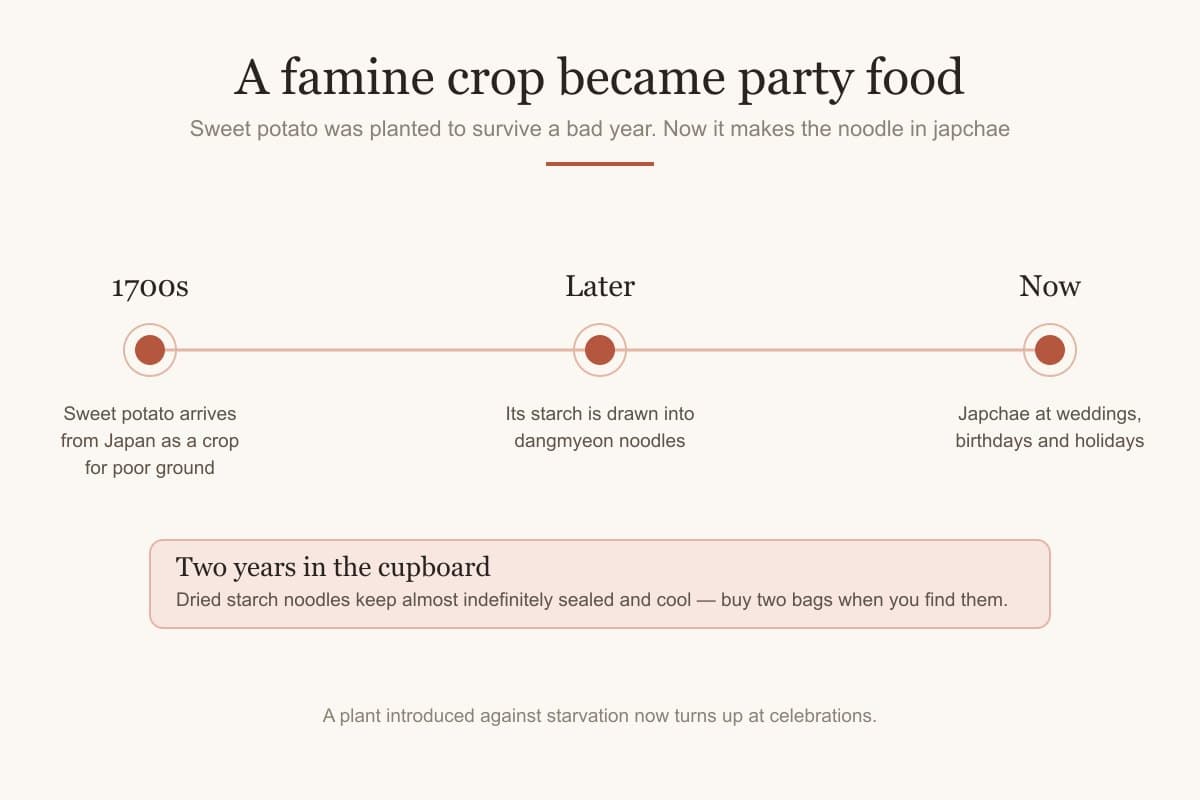
Sweet potato is not native to Korea. It arrived from Japan in the eighteenth century as a famine crop, planted because it would grow on poor ground where rice would not and could keep a household alive through a bad year. The starch noodle came later. A plant introduced to prevent starvation now produces the noodle in japchae, which is party food — the dish Korean households make for weddings, birthdays and holidays.
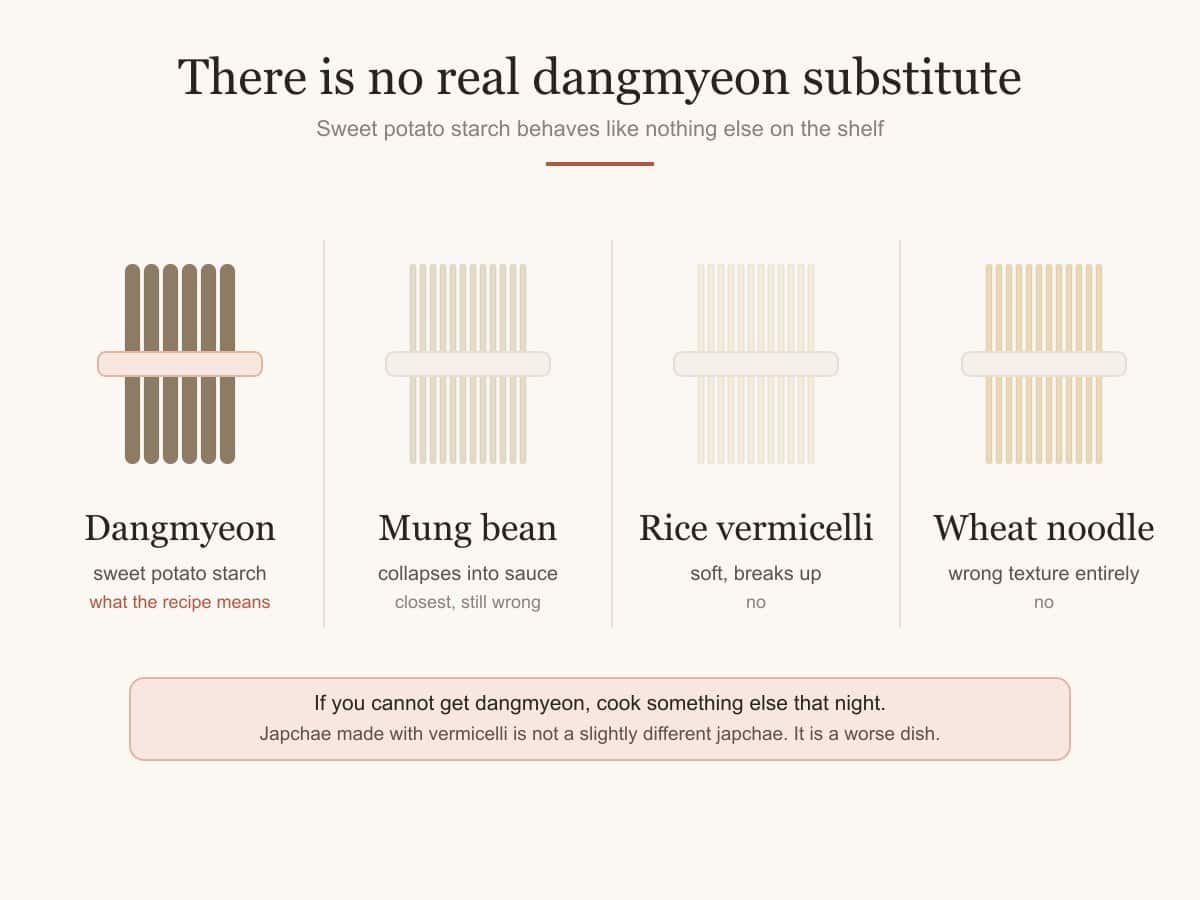
This is the substitution question with the least satisfying answer on the site: there is no good substitute for dangmyeon.
Korean sweet potato starch noodles are thick, grey-brown when dry, and springy to the point of being almost rubbery when cooked. That chew is the entire reason japchae tastes the way it does, and nothing else on a supermarket shelf reproduces it.
Why mung bean vermicelli is not the same
Both get sold as "glass noodles", which is where most of the trouble starts. They are different products made from different plants.
Mung bean vermicelli is much thinner and far softer. In a stir-fry it does not hold its shape — it goes limp and collapses into the sauce within a minute or two of being tossed.
It is a perfectly good noodle in its own dishes. It is simply not this one. Japchae made with it is not a slightly different japchae; it is a worse dish wearing the same name.
What to do if you cannot find dangmyeon
Cook something else that night. That is the honest advice, and it is cheaper than being disappointed by a dish you were looking forward to.
If you have the ingredients for japchae already, bibim guksu or jjolmyeon use similar vegetables and a chewy noodle that is easier to source.
If you must substitute, mung bean vermicelli is the least bad option. Cook it a minute under the packet time, rinse it cold, and add it to the pan at the very last moment with the heat off. You are managing a shortfall rather than fixing it.
Buying and storing it
Dangmyeon keeps extremely well — two years sealed in a cupboard, no refrigeration. Given how hard it can be to find, buying two bags when you see them is sensible.
It is sold in most Korean and many general Asian groceries, usually in a large clear bag, and online without difficulty. Look for dangmyeon, sweet potato starch noodle, or Korean glass noodle — and check the ingredients say sweet potato rather than mung bean, because the English labelling is unreliable.
See Korean noodles explained for how it sits against the others.
Cooking it so it does not disappoint
Six to eight minutes in plenty of boiling water, until fully translucent with no white core. An undercooked strand stays stubbornly hard no matter how long it then sits in the pan.
Rinse briefly in cold water and cut it a few times with scissors, or it is unmanageable to eat.
Dress it while warm. Dangmyeon firms up and clumps as it cools, and sauce added afterwards sits on the outside instead of soaking in.
Common questions
What can I use instead of dangmyeon?
Nothing reproduces it properly. Mung bean vermicelli is the least bad option — cook it a minute short, rinse cold, and add it off the heat at the last moment. Expect a softer dish than the one you intended.
Are dangmyeon and glass noodles the same?
"Glass noodles" covers at least two unrelated products. Dangmyeon is made from sweet potato starch and stays chewy; mung bean vermicelli is thinner and collapses. Check the ingredients rather than the English name.
How long does dangmyeon keep?
About two years sealed in a cool cupboard, with no refrigeration needed. Given how irregularly it appears in shops, it is worth buying more than one bag at a time.
Why are my glass noodles hard in the middle?
They were undercooked. Dangmyeon needs six to eight minutes and must turn fully translucent with no white core — and once it has gone into the pan underdone, more time in the sauce will not rescue it.
More to cook
All Ingredient & Substitute Guides
Dasima & Dried Anchovy Stock (Yuksu)
What dasima (dried kelp) is, why it's simmered with dried anchovies for Korean soup bases, and how long is actually enough.
Doenjang (Fermented Soybean Paste)
What doenjang is, how it differs from Japanese miso, and how to use its stronger, funkier flavor without overdoing it.
Doenjang vs Miso
Both are fermented soybean paste, and swapping one for the other changes a dish more than people expect. What separates them, and when the substitution works.