Did you know — Korean culture
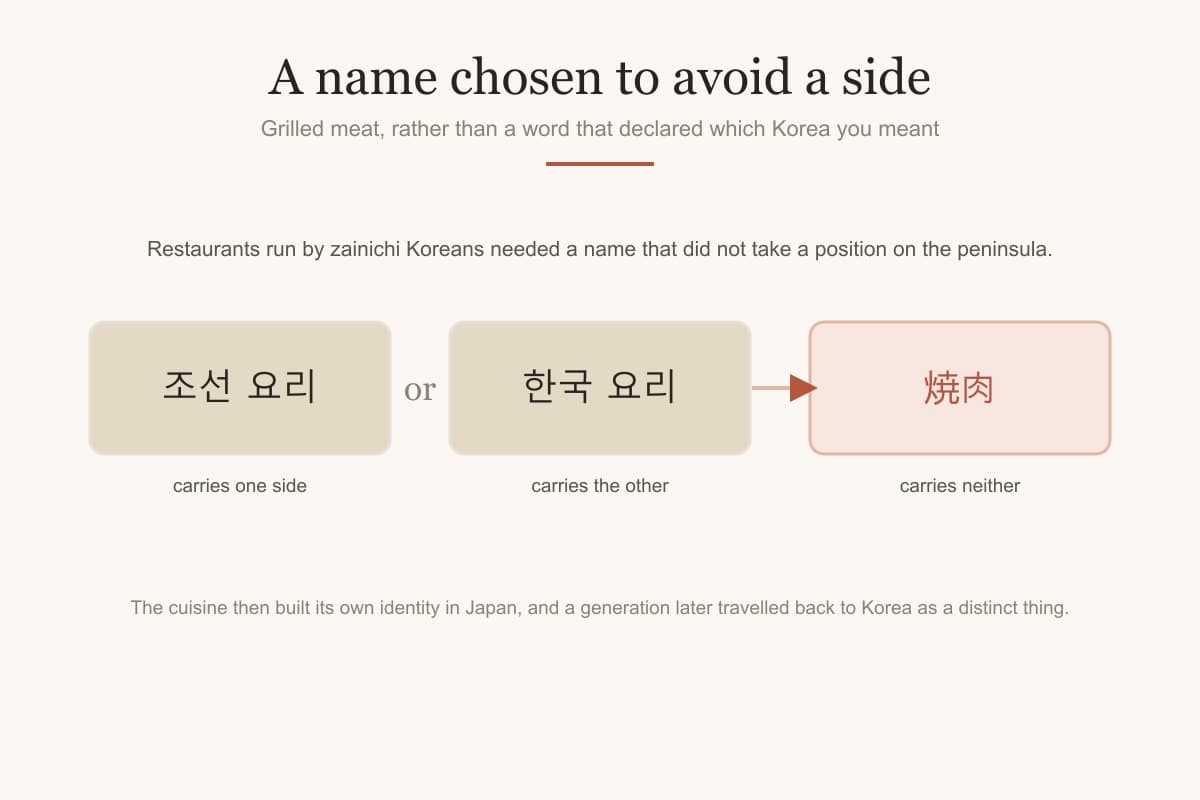
Yakiniku was built by Korean residents in Japan, and the word itself was a rebranding. Restaurants run by zainichi Koreans in the postwar decades were commonly called chōsen ryōriya or kankoku ryōriya — names that carried the political split on the peninsula with them — and *yakiniku*, simply grilled meat, became the neutral term that let a restaurant avoid declaring a side. The cuisine then developed its own identity in Japan, and a generation later began travelling back to Korea as a distinct thing.
Yakiniku descends fairly directly from Korean barbecue, brought to Japan by Korean residents in the twentieth century. The two have since diverged, mostly around what else is on the table.
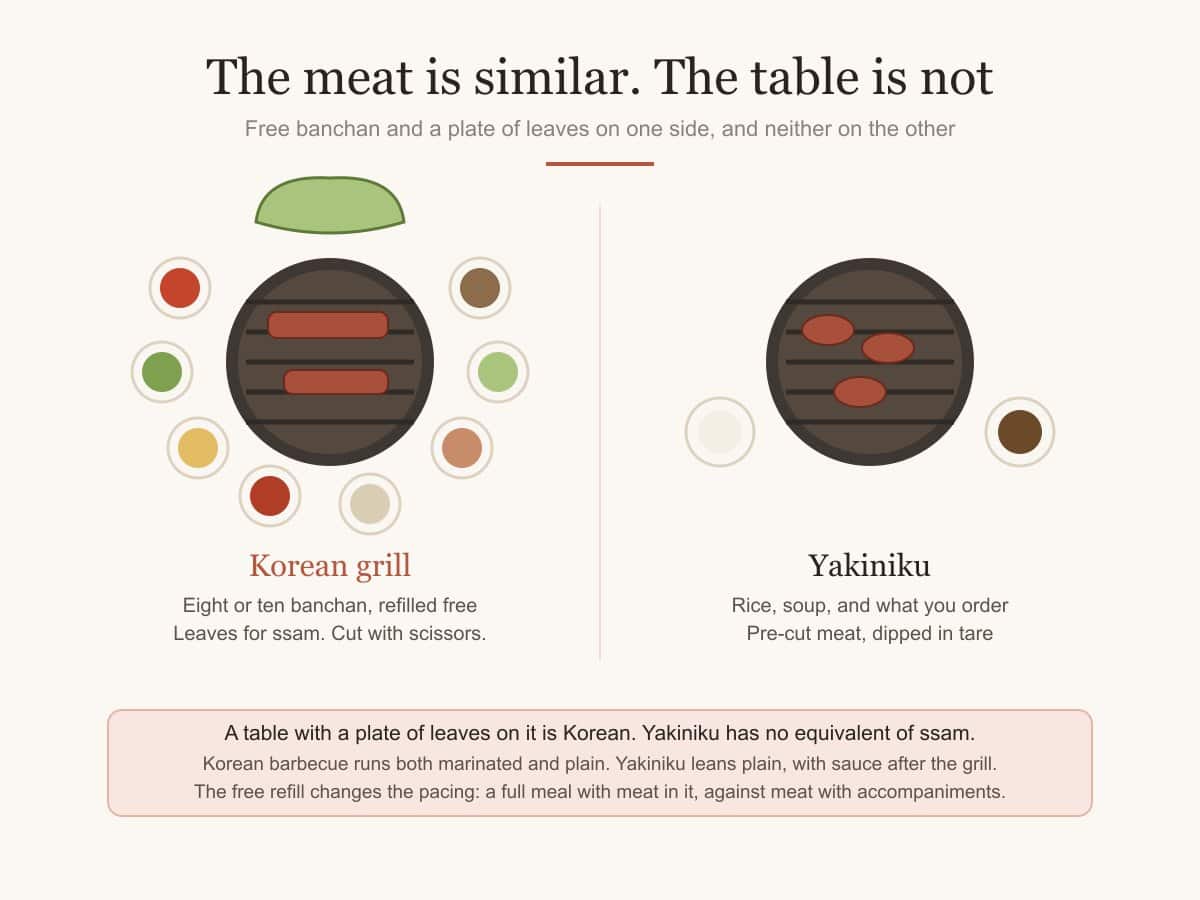
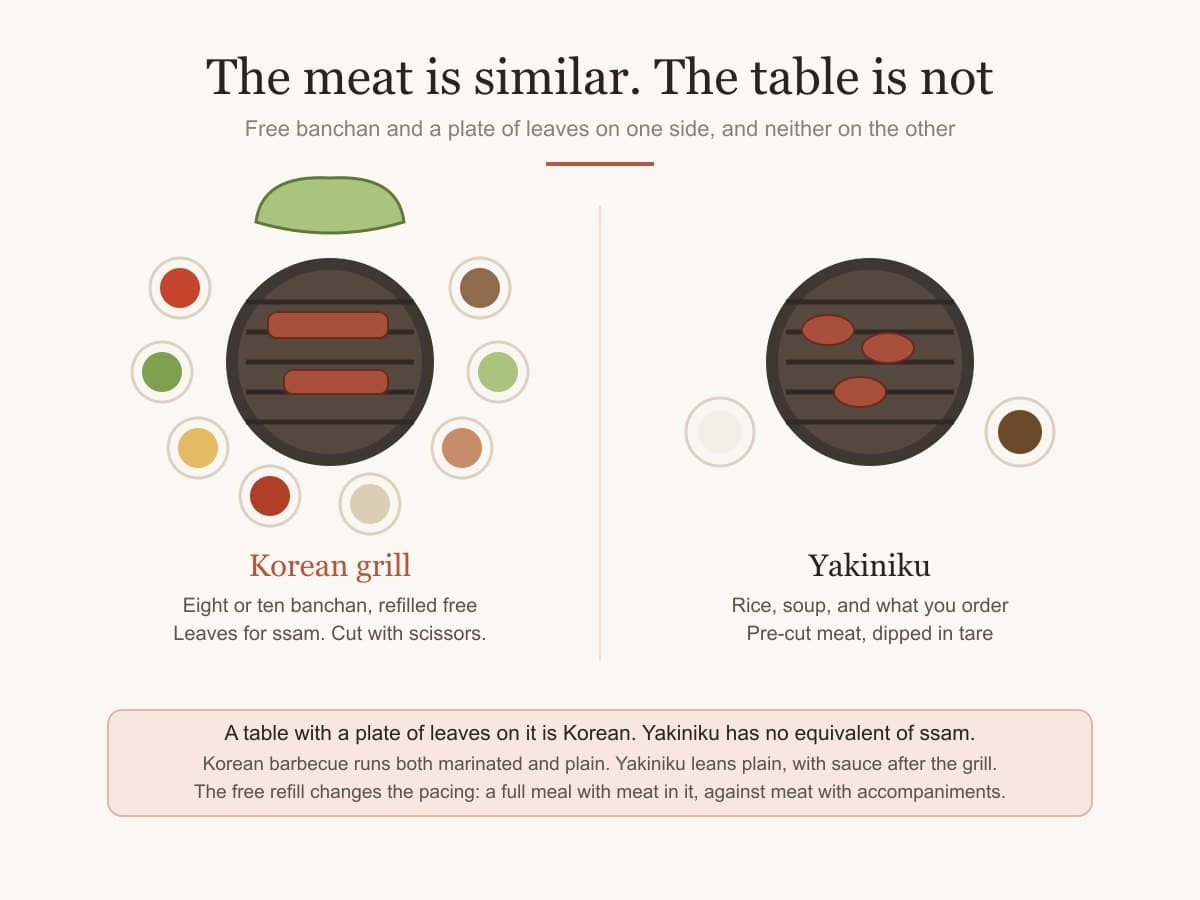
The meat is similar. The table is not.
Marinated against plain
Korean barbecue runs both ways. Yangnyeom galbi and bulgogi are marinated; samgyeopsal and saeng galbi go on the grill plain and are seasoned afterwards.
Yakiniku leans plain. The meat is usually unmarinated and dipped in tare after grilling, which is a sauce rather than a marinade.
That changes the cooking: a sugary Korean marinade needs managing on the grill, and plain meat does not.
What covers the table
This is the real difference. Korean barbecue comes with banchan — often eight or ten small dishes, refilled free: kimchi, namul, pickles, steamed egg, a soup.
Yakiniku comes with much less: rice, soup, perhaps kimchi and a salad, mostly ordered.
The free refill is specific to Korea and it changes how the meal is paced. A Korean grill table is a full meal with meat in it; a yakiniku table is meat with accompaniments.
The wrap
Ssam is central to Korean barbecue — a lettuce or perilla leaf, meat, rice, ssamjang, raw garlic, folded and eaten in one bite.
Yakiniku has no equivalent. Meat goes from the grill to the dip to the rice.
It is the clearest single tell. A table with a plate of leaves on it is Korean.
Equipment and cuts
Korean grills are often charcoal with a round grate or a slotted plate, and the meat is cut with scissors on the grill as it cooks — pork belly especially, which goes on whole and is cut once it has firmed.
Yakiniku is more often gas or a small charcoal brazier, and the meat is pre-cut into bite-sized pieces.
Yakiniku also runs further into offal as a specialism — horumon is a category of its own. Korean grilling does too, with gopchang and makchang, but these are usually separate restaurants rather than part of the same menu.
Common questions
Is yakiniku Korean or Japanese?
Japanese, with Korean origins. It was developed by Korean residents in Japan in the twentieth century and has since diverged, particularly around the side dishes and the absence of a wrap.
What is the biggest difference between Korean BBQ and yakiniku?
The table. Korean barbecue arrives with eight or ten free banchan and a plate of leaves for wrapping; yakiniku comes with rice, soup and whatever else you order.
Is Korean BBQ meat always marinated?
No. Yangnyeom galbi and bulgogi are; samgyeopsal and saeng galbi go on plain and are seasoned afterwards with salt, sesame oil and ssamjang.
Do they use the same cuts?
Broadly, with different handling. Korean grills often cook pork belly whole and cut it with scissors on the plate; yakiniku meat is usually pre-cut into bite-sized pieces before it arrives.
More to cook
All Ingredient & Substitute Guides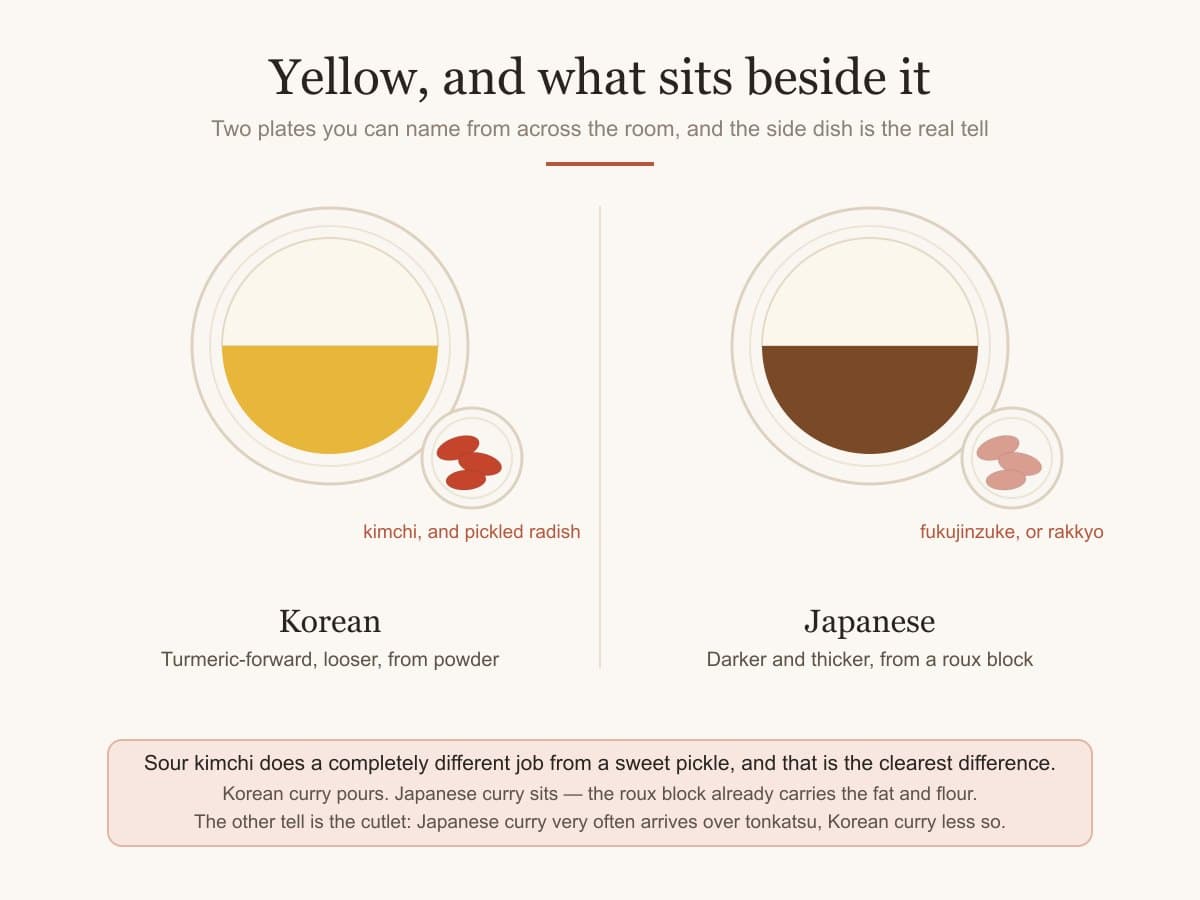
Korean Curry vs Japanese Curry
Korean curry came through Japan and then went its own way. Colour, thickness, spicing and what sits on the plate beside it.
Korean Noodles Explained
Dangmyeon, somyeon, naengmyeon, kalguksu and the rest — which Korean noodle goes in which dish, and which ones you genuinely cannot substitute.
The Korean Pantry: What to Buy First
The ten things that unlock most Korean recipes, what each one actually does, and which ones have no substitute worth attempting.