Did you know — Korean culture
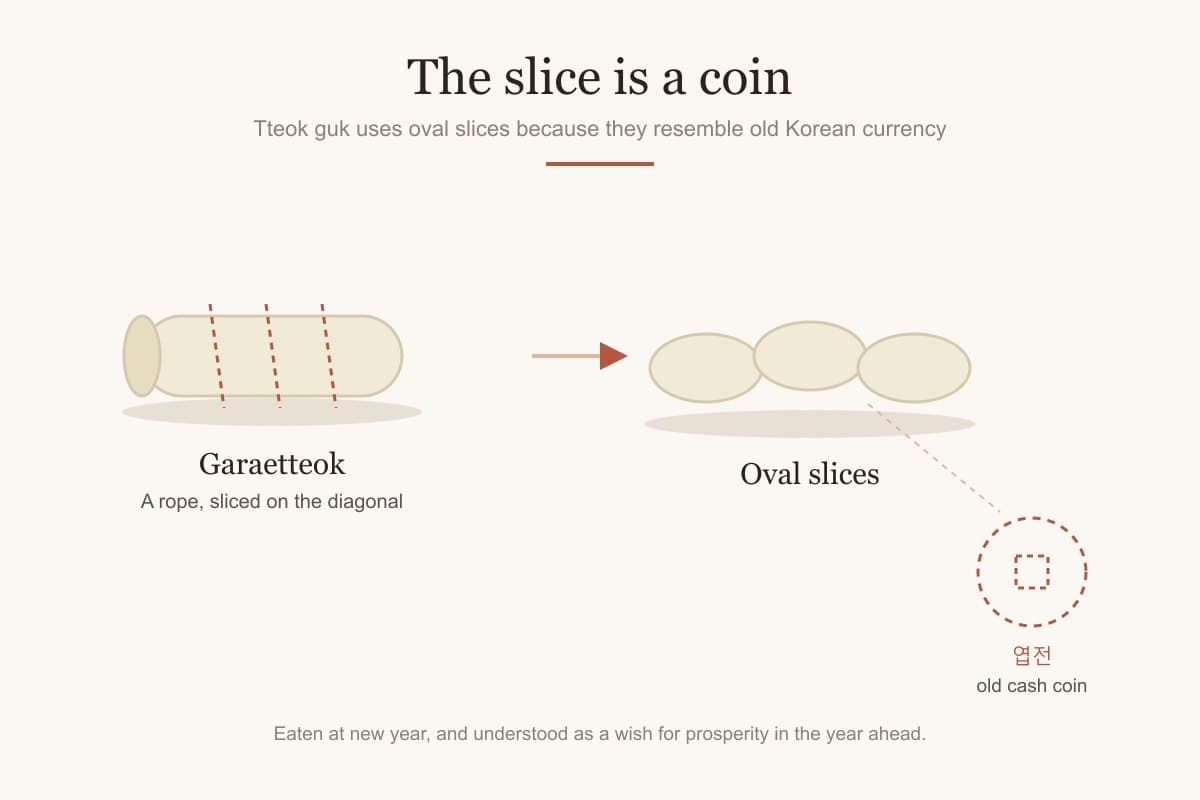
The long cylinder of garaetteok exists for a practical reason that outlived its purpose. Rolling the pounded rice into a rope made it easy to store and, crucially, easy to slice into coins — and the coin shape was deliberate. Tteok guk, eaten at new year, uses those oval slices because they resemble old Korean currency, and eating them was understood as a wish for prosperity in the year ahead. The shape of the rice cake in your soup is a coin.
Both are rice pounded into a chewy cake, and the family resemblance is real. The difference that matters is what rice goes in, and it changes everything downstream.
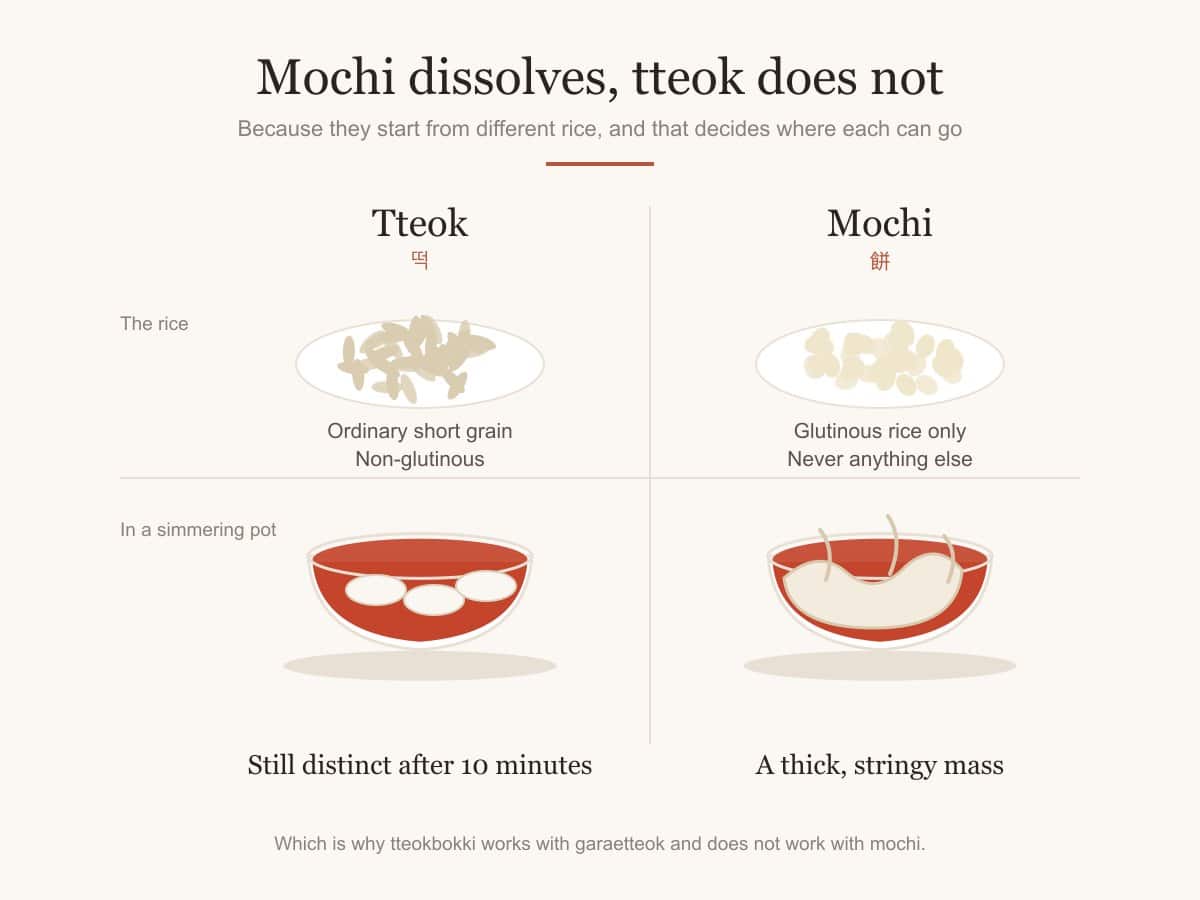
Mochi is always glutinous rice. Tteok often is not. That single fact explains why tteok turns up in soups and stir-fries while mochi mostly does not.
The rice is the difference
Mochi is made from steamed glutinous rice pounded to a smooth, elastic, sticky mass. It stretches.
Tteok is a whole category rather than one product. The savoury ones — garaetteok, the cylinders in tteokbokki, and the oval slices in tteok guk — are made from ordinary non-glutinous short-grain rice. They are chewy but firm, and they hold their shape in liquid.
Korea does make glutinous-rice cakes too — chapssaltteok is essentially the same idea as daifuku mochi. That is the overlap, and it is a small corner of a large category.
Why that matters in cooking
Non-glutinous tteok can be simmered in a stew for ten minutes and still be a distinct object. Mochi in the same pot dissolves into a thick, stringy mass.
This is why tteokbokki works and why a mochi version of it does not. It is also why tteok guk is a clear soup with slices floating in it rather than a porridge.
If a recipe calls for garaetteok, mochi is not a substitute. See dangmyeon substitutes for the same problem with noodles.
Sweet against savoury
Mochi is overwhelmingly sweet in its common forms — filled with red bean, ice cream, fruit.
Tteok runs both ways. Savoury tteok is everyday food: stir-fried, skewered as tteok kkochi, dropped into soup. Sweet tteok exists and is ceremonial more than casual — songpyeon at Chuseok, injeolmi rolled in bean powder.
A Korean would not usually call tteok a dessert. A Japanese person would usually place mochi there.
Storing either one
Both harden through the same process, and both harden fastest in the fridge — see why rice cakes go hard.
Same day: room temperature, wrapped. Longer: freeze.
Warm water or steam brings plain tteok back well. Mochi recovers less predictably, and filled cakes of either kind recover least.
Common questions
Is tteok the same as mochi?
Not quite. Mochi is always glutinous rice; most savoury Korean tteok is made from ordinary short-grain rice, which is why it holds its shape in soup instead of dissolving.
Can I use mochi in tteokbokki?
No. Mochi breaks down in simmering sauce into a stringy mass. Tteokbokki needs non-glutinous garaetteok, which stays as distinct chewy cylinders.
Is tteok a dessert?
Mostly not. Savoury tteok is everyday food — stir-fried, skewered, dropped into soup. Sweet tteok exists but tends to be ceremonial, eaten at holidays rather than as a casual pudding.
Why is my tteok dissolving in the pot?
You probably have a glutinous-rice cake rather than garaetteok, or the cakes were already very soft. Non-glutinous tteok should survive ten minutes of simmering intact.
More to cook
All Ingredient & Substitute Guides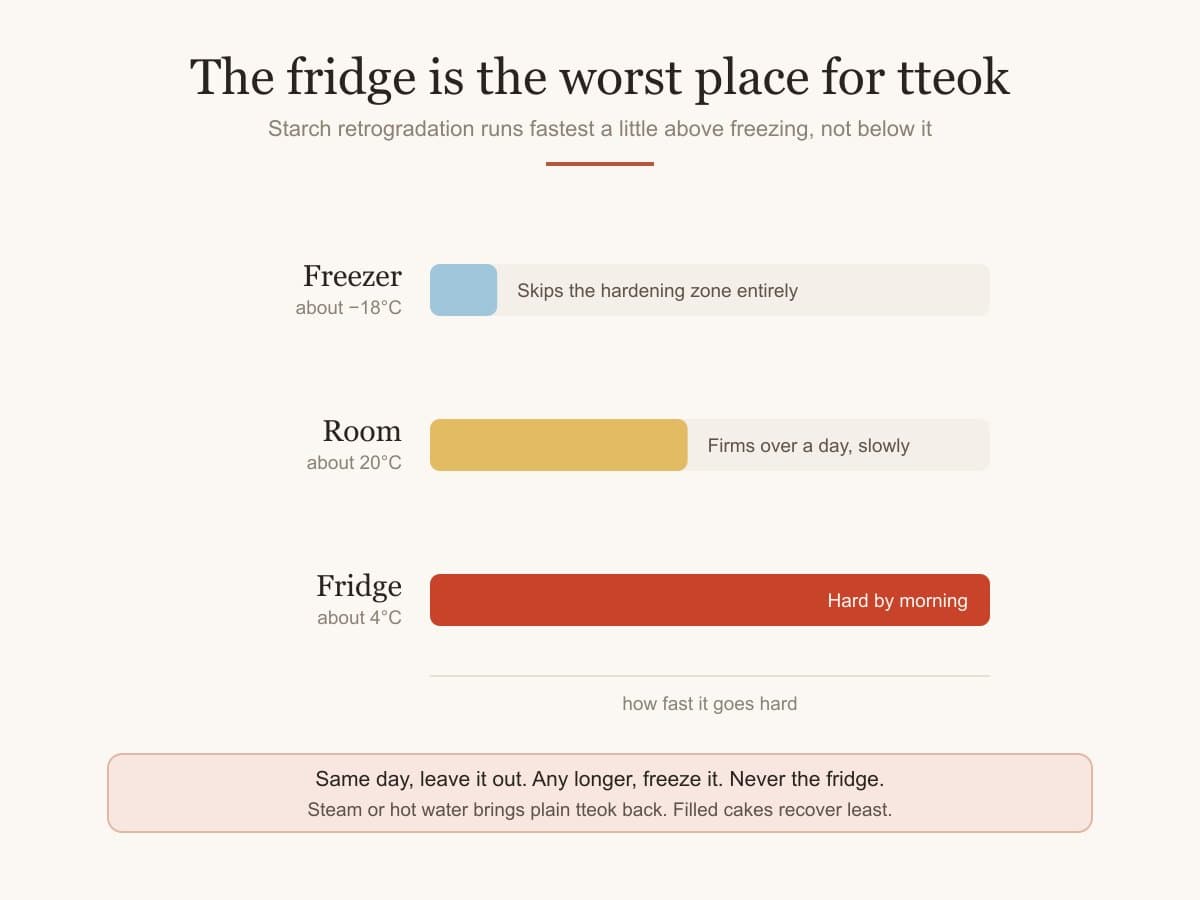
Why Did My Tteok Go Hard?
Rice cakes harden in the fridge because of starch retrogradation, not drying out. What that means in practice and how to bring them back.
Why Is My Bulgogi Tough?
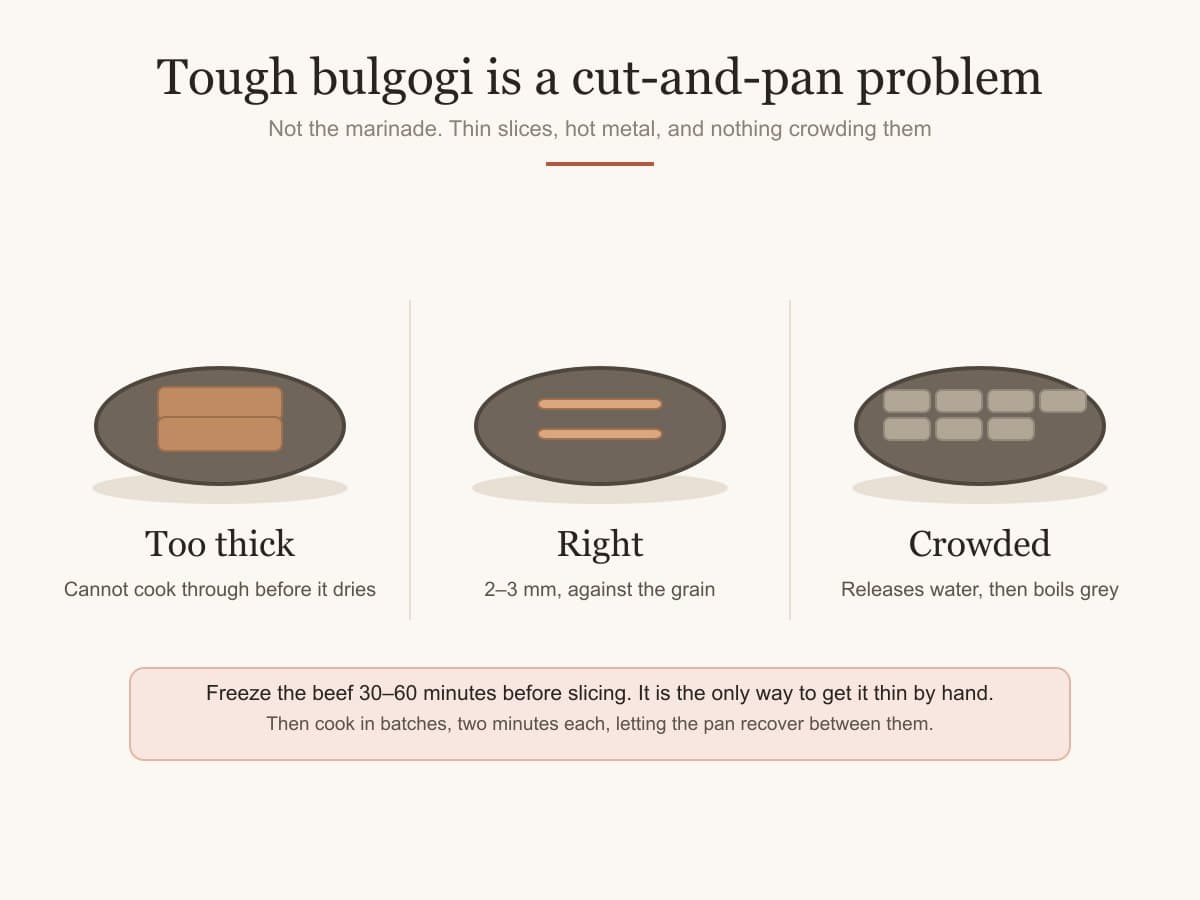
Tough bulgogi is almost never the marinade. The three real causes are the cut, the thickness and a crowded pan, and all three are easy to fix.
Why Is My Doenjang Jjigae Bitter?
Bitterness in doenjang jjigae almost always comes from the paste or the boil, not the vegetables. How to find which, and how to fix it mid-pot.