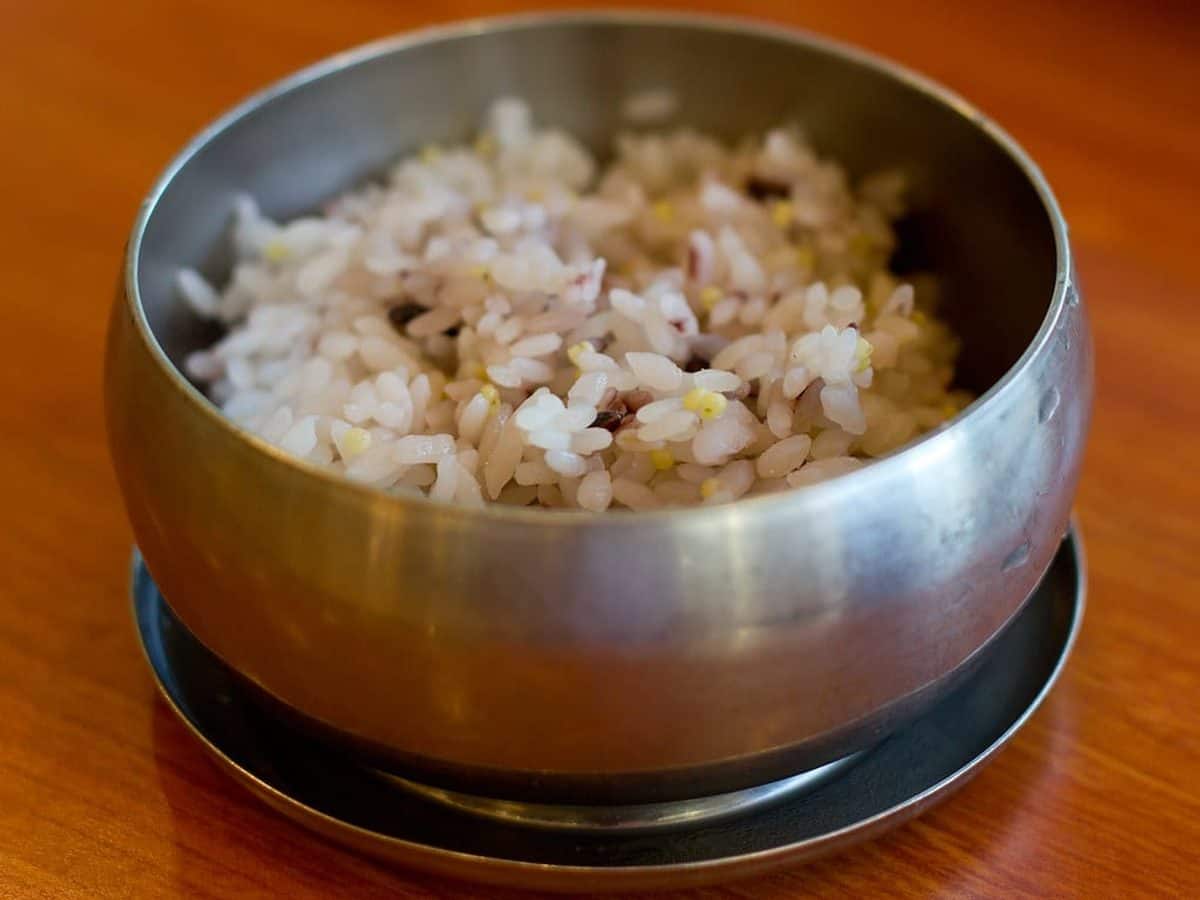
Photo: Symic · CC BY-SA
Did you know — Korean culture
Multigrain rice has a specific ceremonial ancestor: ogokbap, the five-grain rice eaten at Jeongwol Daeboreum, the first full moon of the lunar year. Tradition held that you should eat it three times that day, and share it across at least three households — children would go door to door collecting a spoonful from each. [Ogokbap](/recipes/ogokbap) uses a fixed five grains; everyday japgokbap is the same idea without the rules.
Japgokbap is rice cooked with a mixture of other grains and beans — the everyday Korean answer to plain white rice. There is no fixed formula; households have their own blends, and packaged mixes are sold ready-portioned.
The common additions are barley, black rice, sweet brown rice, millet, sorghum, and beans of some kind. What they share is that none of them cook at the same rate as white rice, which is the entire technical problem.
Keep white rice the majority
A workable ratio is 70% white rice to 30% everything else. Push the mixed grains higher and the result gets heavy and dry rather than interesting.
If you are starting out, three additions is plenty. A blend of eight grains is a packaged product, not a beginner's target.
Different grains, different soaks
This is what separates good japgokbap from a pot with hard beans in it:
- Beans (black soy, kidney) — soak overnight, or parboil
- Barley, sorghum — 1-2 hours
- Black rice, brown sweet rice — 1 hour
- Millet, white rice — 30 minutes
Soak the slow things first and add the fast ones later into the same bowl of water. Then cook everything together.
Add a little more water
Mixed grains absorb more liquid than white rice. Increase the water by roughly 10-15% over your usual rice setting.
A rice cooker with a multigrain setting is doing exactly this plus a longer soak cycle — if yours has one, use it rather than second-guessing.
Why black rice colours everything
A small amount of black rice will turn an entire pot purple, which is normal and is the point for most people. If you want the colour without a strong flavour shift, a tablespoon in a full pot is enough.
Cooking it in a rice cooker vs on the stove
Rice cooker with a multigrain setting: use it. That setting is doing a longer soak and a longer cook, which is exactly what mixed grains need.
Rice cooker without one: soak the grains separately as described, then use the normal white rice setting with about 10% more water.
Stovetop: bring to a boil uncovered, then lid on and lowest heat for 18–20 minutes — longer than plain white rice — followed by 10 minutes off the heat, lid on.
Pressure cooker: genuinely the best tool for beans and whole grains, and it removes most of the soaking problem. About 8 minutes at pressure with natural release.
Storing and eating it
Japgokbap keeps and reheats better than plain white rice, because the mixed grains hold less water and go less chalky when cold.
Fridge: 3–4 days. Freezer: portion it warm and freeze; it reheats well from frozen.
It is not the rice for everything. For kimbap you want plain short-grain, because japgokbap does not compress or hold together the same way. For bibimbap it works and is common. For plain eating alongside a stew it is arguably better than white rice.
Start with a low proportion of grains if you are cooking it for people who are used to white rice. Jumping straight to a 50/50 blend is the usual reason someone decides they do not like it.
Common questions
What grains go in japgokbap?
There's no fixed formula — barley, black rice, sweet brown rice, millet, sorghum and beans are the usual additions. Three is plenty to start; an eight-grain blend is a packaged product, not a beginner's target.
Why are the beans still hard in my multigrain rice?
They needed a much longer soak than the rice. Beans want overnight or a parboil; barley and sorghum want one to two hours; millet and white rice want thirty minutes. Soak the slow things first and add the fast ones to the same bowl later.
How much water do you use for japgokbap?
About 10–15% more than for plain white rice, because the mixed grains absorb more. If your rice cooker has a multigrain setting it handles this along with a longer soak.
Why does my japgokbap turn purple?
Black rice. Even a tablespoon will colour a whole pot, which is normal and is the point for most people. Use less if you want the effect without a strong flavour shift.
More to cook
All Ingredient & Substitute Guides
Jocheong (Korean Rice Syrup)
What jocheong does that sugar cannot, how it differs from clear corn syrup (mullyeot), and why it goes into a glaze at the end rather than the start.
Kimchi 101: A Complete Guide
What kimchi actually is, the main types beyond the red cabbage one, how fermentation works, and what to do when a batch goes wrong.
Kkaennip (Perilla Leaves)
Why Korean perilla leaves are not shiso despite looking similar, how they're used in ssam and jangajji, and what to do if you can't find them fresh.