Did you know — Korean culture
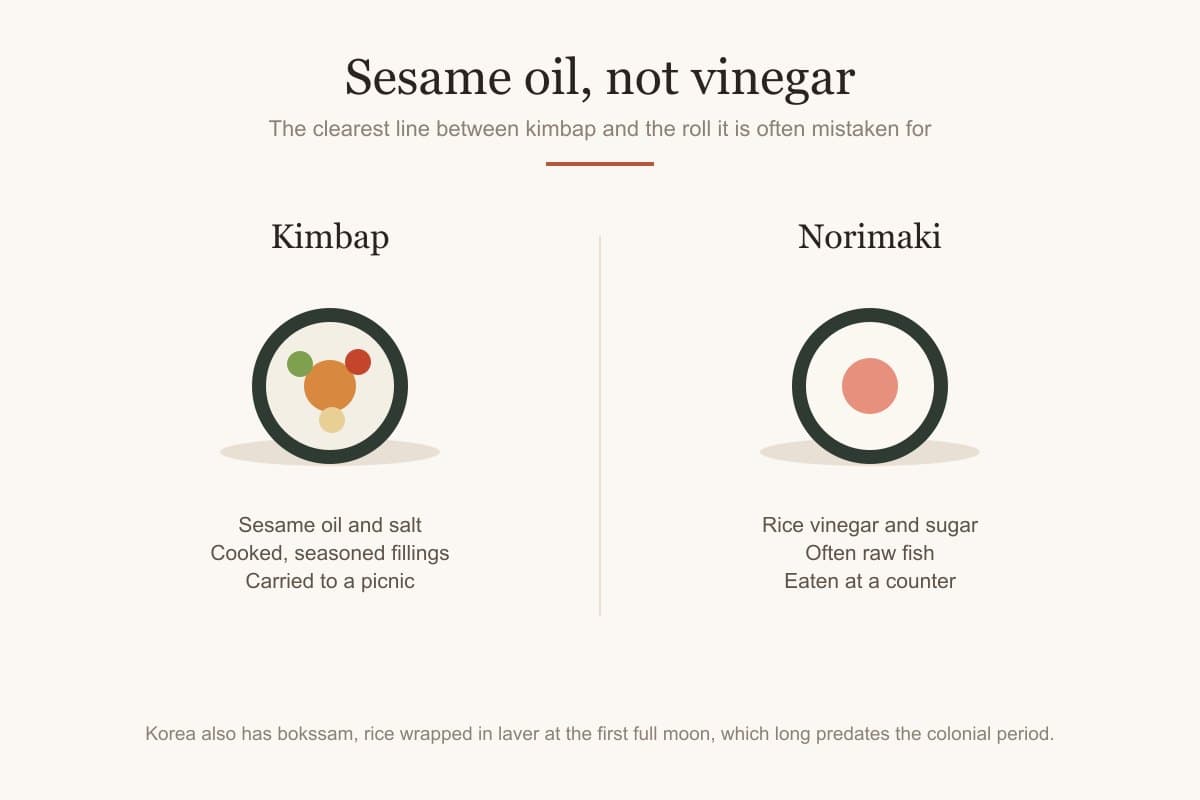
Whether kimbap descends from Japanese norimaki is genuinely contested, and the sesame-oil seasoning is the strongest argument that it does not simply copy it. Korea has its own long tradition of wrapping rice in laver — bokssam, eaten at the first full moon of the year, wraps rice in seaweed and predates the colonial period. What is not contested is that kimbap went its own way: no vinegar, sesame oil instead, cooked and seasoned fillings rather than raw fish, and a roll built to be carried to a picnic rather than eaten at a counter.
A roll that collapses on the board is usually blamed on technique. In practice it is one of three mechanical problems, and all three are easier to fix than rolling practice.
Rice too wet, roll too full, knife too blunt. Work through them in that order.
The rice is too wet, or too hot
Kimbap rice is cooked slightly drier than table rice, seasoned with sesame oil and salt rather than vinegar, and spread while warm but never hot.
Steaming rice softens the gim from underneath. By the time you roll, the sheet has lost its structure and tears along the fold.
Cook with about a tenth less water than usual, spread it on a tray to let the steam off, and start rolling when it is warm to the hand rather than hot.
There is too much in it
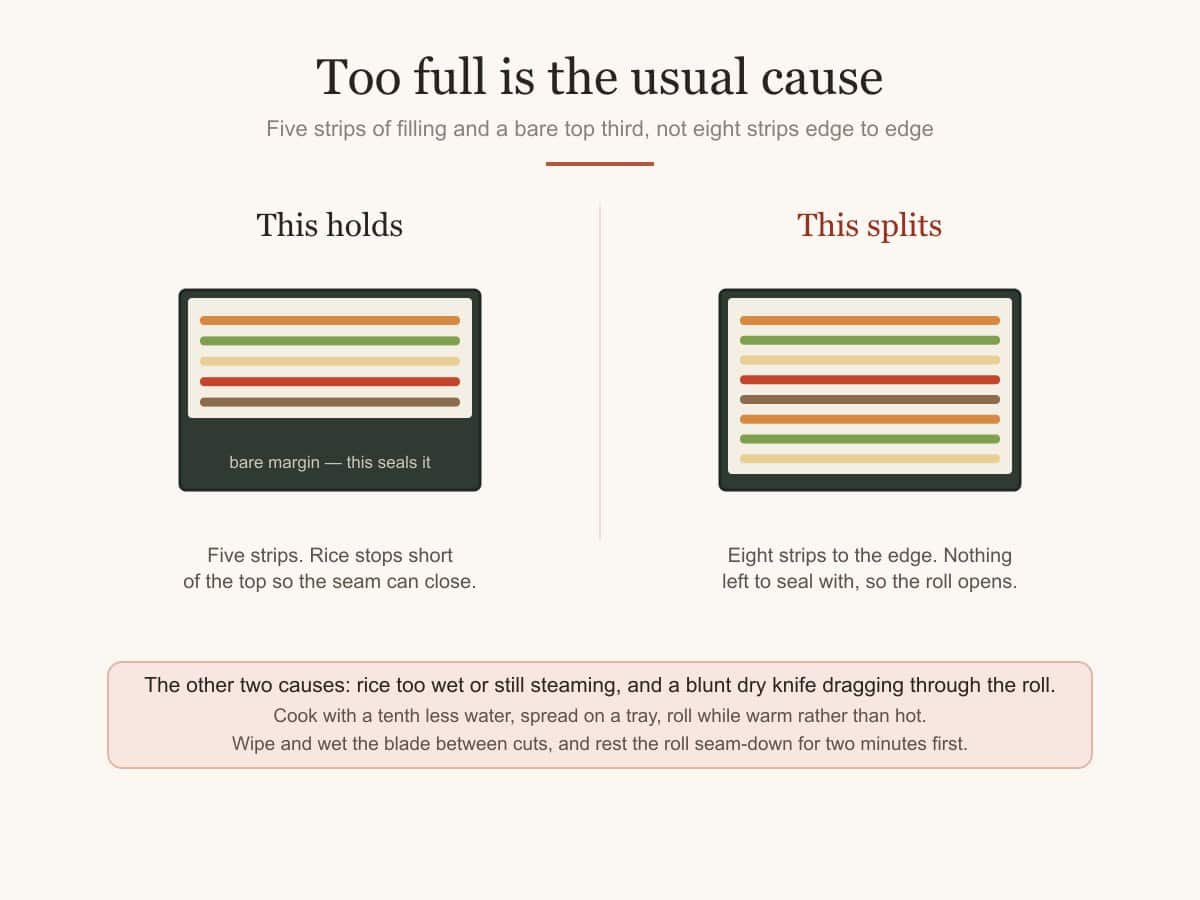
This is the cause people resist most. A kimbap roll takes less filling than it looks like it should — four or five strips, not eight.
Overfilling has two effects: the gim cannot close with an overlap, and the filling pushes outward when you cut, splitting the seam.
Leave the top third of the sheet bare. That strip is what seals the roll, and if filling reaches it there is nothing to seal with.
The knife is blunt, or dry
A blunt knife drags rather than cuts, and dragging is what unravels a roll.
Use the sharpest knife you own, wipe the blade between cuts, and wet it lightly — a damp cloth beside the board is the usual setup. Sawing gently beats pressing down.
Brushing the finished roll with sesame oil before cutting helps as well, and is what gives shop kimbap its shine.
Rolling it so it holds
Seam-side down, and let it sit. A roll rested for two or three minutes on its seam holds together far better than one cut immediately.
Use the mat to compress as you go rather than only at the end: tuck the near edge over the filling, pull back against the mat to tighten, then roll forward in one movement.
If the sheet still will not close, the gim may simply be stale. Old gim goes brittle and cracks along the fold no matter how well you roll.
Common questions
Why does my kimbap fall apart when I cut it?
Usually a blunt knife dragging through the roll, or too much filling pushing the seam open. Wipe and wet the blade between cuts, saw gently, and use four or five strips of filling rather than eight.
Should kimbap rice be hot or cold?
Warm. Hot rice steams the gim from underneath and the sheet tears along the fold; cold rice will not stick to itself. Spread it on a tray to release steam first.
Do you use vinegar in kimbap rice?
No. That is sushi rice. Kimbap rice is seasoned with sesame oil and salt, which is one of the clearest differences between the two dishes.
How much filling should go in a kimbap roll?
Less than instinct suggests — four or five strips. Leave the top third of the sheet bare, because that strip is what seals the roll.
More to cook
All Ingredient & Substitute Guides
Why Is My Kimchi Not Sour?
The four things that stall kimchi fermentation — temperature, salt level, sugar and airtightness — and how to tell which one is your problem.
Why Is My Kimchi Slimy?
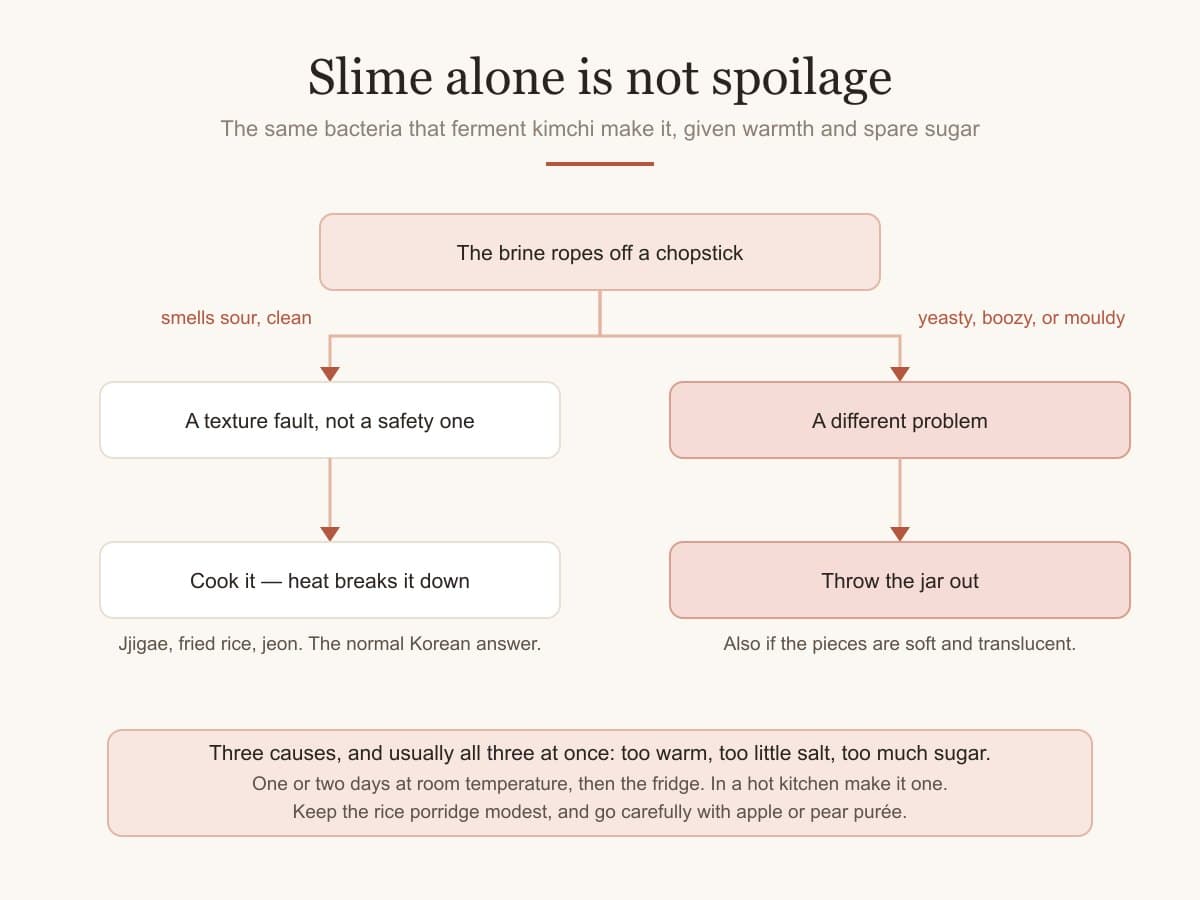
Slimy or stringy kimchi brine is usually harmless and always preventable. What causes it, when to throw the jar out, and how to avoid it next time.
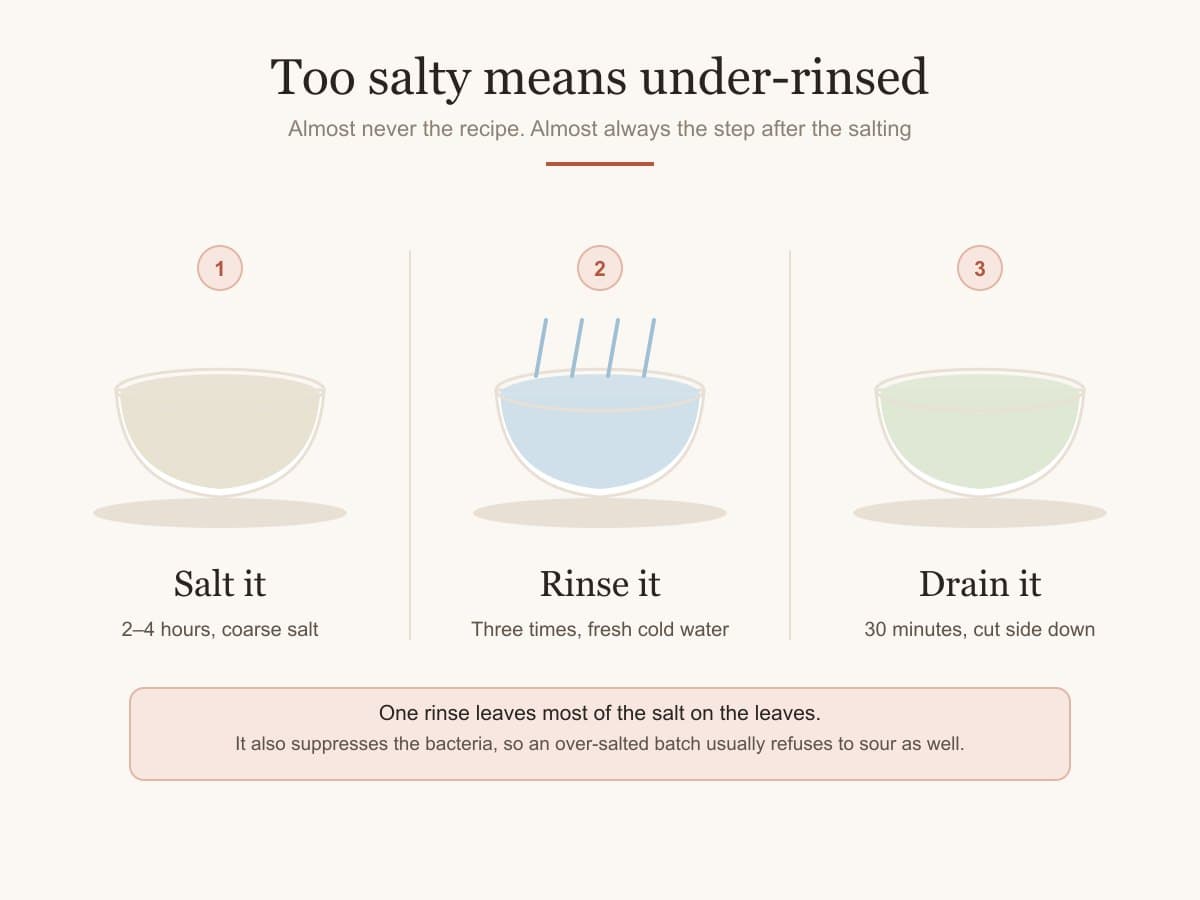
Why Is My Kimchi Too Salty?
Over-salted kimchi almost always comes from the rinse, not the recipe. How to tell, what to do with the batch you have, and how to get it right next time.