Steps
- 1
Whisk the acorn starch into the cold water with the salt until completely smooth, with no lumps. Let it stand 10 minutes.
- 2
Pour into a heavy pot and bring to a simmer over medium heat, stirring constantly with a wooden spoon from the moment it goes on.
- 3
Keep stirring as it thickens. It will go cloudy, then suddenly turn glossy and heavy — this takes about 10 minutes and the change is abrupt.
- 4
Once it is glossy and a spoon drawn through leaves a trail, drop the heat to low and keep stirring another 5 minutes. This step decides whether it sets firm.
- 5
Stir in the neutral oil, then pour into a shallow square dish and smooth the top.
- 6
Cool to room temperature, uncovered, for about an hour, then refrigerate 2 hours until fully set.
- 7
Mix the soy sauce, gochugaru, spring onion, garlic, sesame oil, sesame seeds and sugar into a dressing.
- 8
Turn out, cut into 1.5 cm batons, lay over shredded lettuce and spoon the dressing over just before serving.

Did you know — Korean culture
Acorns were a famine crop, and dotorimuk is what survived of that. Korean oak forests produce heavily and reliably in years when the rice fails, and acorn starch keeps for a long time once leached and dried, so it was stockpiled as insurance rather than eaten by choice. The dish carried that association well into the twentieth century. Its reputation inverted only as the country got richer and acorn starch became laborious and expensive to produce — the same bitterness that marked it as poverty food now marks it as a speciality.
Dotorimuk is acorn starch set into a firm, faintly bitter jelly, cut into batons and dressed with soy and chilli. It is a banchan in summer and a drinking snack year round.
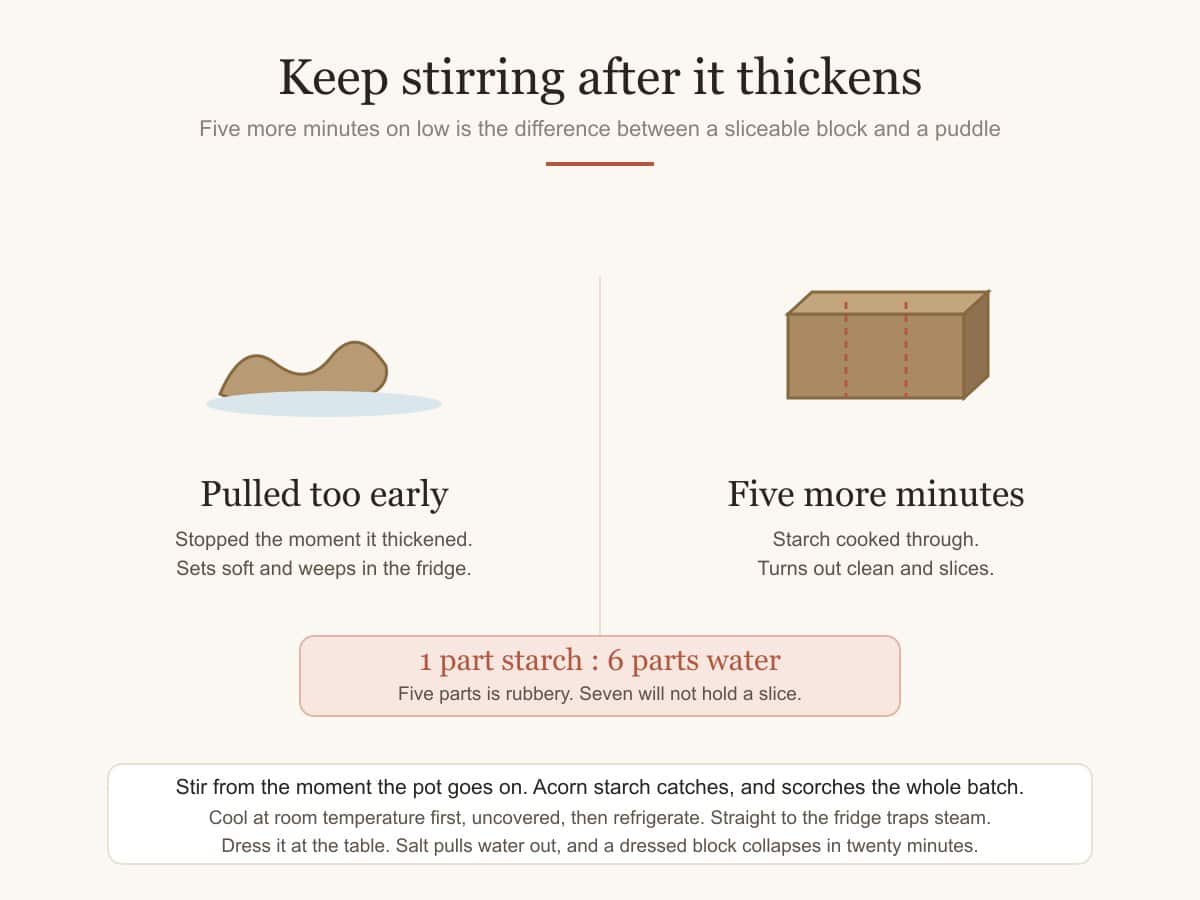
It is also one of the easiest Korean dishes to get wrong, and the failure is always the same: it does not set, because it was not cooked long enough after it thickened.
The ratio, and the part after the thickening
One part acorn starch to six parts water by volume is the standard. Five parts gives a firmer, rubbery muk; seven gives one that will not hold a slice.
The mixture thickens suddenly, around ten minutes in, and the instinct is to stop there. Do not. Another five minutes of stirring on low heat is what cooks the starch through, and a muk pulled at the moment it thickens sets soft and weeps water in the fridge.
Stir from the moment the pot goes on the heat, not from when it starts to thicken. Acorn starch catches and scorches easily, and a scorched batch tastes burnt all the way through.
Cool it twice
Room temperature first, uncovered, for about an hour. Putting a hot pot of muk straight into the fridge traps steam, and the condensation sits on the surface and softens it.
Then two hours cold to set properly. It will keep three days in the fridge but is best on the first.
The teaspoon of neutral oil stirred in at the end is not for flavour — it keeps the surface from drying into a skin and makes the block turn out of the dish cleanly.
Dress it at the table
Never dress muk in advance. Salt draws water out of the jelly, and twenty minutes under a soy dressing turns a crisp block into a puddle.
The standard dressing is soy, gochugaru, garlic, spring onion, sesame oil and seeds, with a little sugar. Some add a splash of vinegar for a summer version.
Serve it on shredded lettuce or perilla, which keeps the batons from sitting in the liquid that does collect.
What it tastes like, and the other muks
Faintly bitter and slightly nutty, with almost no sweetness. The bitterness is the acorn and is meant to be there; commercial powders are leached to tone it down.
It is one of a family. Memilmuk is made from buckwheat and is paler and softer; cheongpomuk from mung bean is white and the mildest of the three. The method is identical for all of them, only the ratio shifts.
Muk is also eaten as mukbap — batons in cold anchovy broth over rice, which is a summer meal in Gangwon province rather than a side dish.
Common questions
Why did my dotorimuk not set?
Almost always because it was taken off the heat as soon as it thickened. The starch needs another five minutes of stirring on low after that point, or it sets soft and weeps in the fridge.
What is the water ratio for acorn jelly?
One part acorn starch to six parts water by volume. Five parts gives a firmer, rubbery result; seven will not hold a clean slice.
Is dotorimuk supposed to be bitter?
Slightly, yes. The faint bitterness is the acorn, and commercial powders are leached to reduce rather than remove it. A completely bland muk has usually been cut with other starches.
How long does dotorimuk keep?
Three days refrigerated, best on the first. Dress it only at the table — salt pulls water out of the jelly and a dressed block collapses within about twenty minutes.
More to cook
All Banchan
Dubu Buchim (Plain Pan-Fried Tofu)
The pat-dry-and-sear technique behind dubu buchim, and why moisture is the one thing standing between soft tofu and a golden crust.
Dubu Jorim (Braised Tofu)
Why the tofu is pan-fried before it is braised, and how the sauce is reduced around it rather than the tofu being simmered in a full pot of liquid.
Dubu Kimchi (Tofu with Stir-Fried Kimchi)
The steamed-tofu, stir-fried-kimchi pairing behind dubu kimchi, and why the two halves are meant to stay separate on the plate.